Is 18K or 22K Gold Better for an Engagement Ring?

For most engagement rings worn every day, 18K gold is generally the more practical choice, especially when the design includes a diamond or gemstone held by delicate prongs. It contains enough alloying metals to offer greater resistance to bending and deformation than many traditional 22K gold formulations.
However, 22K gold has qualities that make it especially appealing for handcrafted jewelry. Its rich yellow color, high gold content, and distinctive warmth can be beautiful in an engagement ring designed to accommodate the metal's characteristics.
The important question is not simply which gold is purer. It is which gold works best with the ring's design, gemstone setting, and the way it will be worn.
Is 18K or 22K Better for an Everyday Engagement Ring?
An engagement ring is different from a pendant or a pair of earrings. It comes into frequent contact with countertops, door handles, clothing, and other surfaces. Even careful wearers occasionally bump their rings.
Over time, these small contacts can affect the metal, particularly around the gemstone setting.
For a ring with slender prongs, an elevated center stone, or intricate metalwork exposed to everyday contact, 18K gold is often preferable. Many 18K alloys offer a useful balance of gold purity, strength, and workability.
A 22K engagement ring is not necessarily impractical. A substantial band with a low-profile gemstone setting may be a suitable design, depending on the alloy and construction. The higher gold content simply calls for more attention to the areas that experience pressure and wear.
A beautifully made engagement ring should be designed around both the gemstone and the person who will wear it.
What Is the Difference Between 18K and 22K Gold?
The karat number tells you how much pure gold is present in the metal.
Pure gold is designated 24K. Because pure gold is relatively soft and easily deformed, gold used in fine jewelry is commonly mixed with other metals to create an alloy.
How Much Pure Gold Is in Each?
18K gold contains 75% pure gold, with the remaining 25% consisting of other metals.
22K gold contains approximately 91.7% pure gold, with about 8.3% consisting of other metals.
These additional metals may include copper, silver, palladium, or other elements, depending on the desired color and properties.
The difference is significant. A 22K ring contains more gold by weight than an 18K ring of the same total metal weight. But that additional gold does not automatically make it better suited to every jewelry design.
Two rings with the same karat rating can also behave differently because their alloy formulations and fabrication methods are not necessarily identical.
Does 22K Gold Look More Yellow Than 18K?
Usually, yes.
Because 22K gold contains a higher percentage of pure gold, it generally has a deeper, more saturated yellow appearance. Its warmth is one reason high-karat gold is prized in traditional goldsmithing and artistic jewelry.
18K yellow gold typically has a slightly more restrained golden color, although the exact shade depends on the alloy.
For someone who loves the rich appearance of high-karat gold, this distinction may be an important part of the design.
It is also worth remembering that 18K gold is available in different colors, including yellow, rose, and white. These variations come from changes in the alloy composition. A comparison between 18K yellow gold and 22K yellow gold is therefore more meaningful than comparing two unspecified gold alloys.
Which Gold Is More Durable for an Engagement Ring?
Durability involves more than whether a metal feels hard.
An engagement ring must withstand surface scratches, pressure on the band, occasional impacts, and wear around the gemstone setting. These forces do not affect every part of the ring equally.
Scratches and Everyday Surface Wear
Both 18K and 22K gold can scratch.
Many conventional 18K gold alloys are harder than typical 22K alloys, which can make them more resistant to certain kinds of surface damage. However, hardness depends on the precise alloy and how the metal was worked or treated.
Neither karat is scratchproof.
Fine surface marks are part of the normal wear of gold jewelry. Some can be reduced through professional refinishing, although repeated polishing removes small amounts of metal and should not be treated as a substitute for proper care.
Bending and Deformation
Higher-purity gold generally deforms more readily than lower-karat alloys commonly used for engagement rings.
This matters when a ring has a narrow band or small components that hold a gemstone in place.
A broad 22K band may have enough metal to withstand ordinary wear reasonably well. A thin 22K prong, however, may be more vulnerable to bending when it catches on fabric or strikes a hard surface.
The shape and thickness of the metal are therefore just as important as the karat number.
Why Prong Security Matters
Prongs are the small metal projections that hold a gemstone against its setting.
Their job is demanding. They must be thin enough to reveal the gemstone while maintaining enough strength and contact to keep it secure.
A prong that bends or wears down may no longer hold the stone as intended.
For this reason, 18K gold is generally the stronger starting point for a delicate, prong-set engagement ring. It does not guarantee that a gemstone will remain secure, but its typical mechanical properties can be advantageous.
Prong thickness, setting geometry, craftsmanship, and routine inspections remain essential regardless of the metal selected.
Does the Gemstone Setting Change Which Gold Is Best?
Yes. The setting can be one of the most important factors in choosing between 18K and 22K gold.
Two engagement rings made from the same metal may have very different durability characteristics because of how the gemstone is mounted.
Prong Settings and Exposed Gemstones
A traditional solitaire engagement ring often uses four or six prongs to hold the center stone.
This design allows light to reach the gemstone and creates an open, elegant appearance. However, the prongs are exposed to everyday contact.
The risk becomes greater when the prongs are particularly fine or the gemstone sits high above the finger.
For these designs, 18K gold is often a sensible choice. The jeweler can evaluate the prong dimensions, gemstone size, and mounting structure to determine whether the metal provides suitable support.
A delicate setting should never be judged by appearance alone.
Bezel Settings and Protected Gemstones
A bezel setting uses a metal rim that surrounds all or part of a gemstone's edge.
Because the stone is held by a continuous section of metal rather than several individual prongs, a properly designed bezel can provide a more protected, lower-profile setting.
This creates an interesting possibility for 22K gold.
A ring with a substantial band and carefully constructed bezel may accommodate higher-karat gold more successfully than a ring with tall, delicate prongs.
That does not mean every 22K bezel is suitable. The metal thickness, gemstone shape, and amount of support still matter. Softer metal can deform, including around a bezel.
For buyers who love the rich yellow appearance of 22K gold, a protective setting is worth discussing with a goldsmith.
Can an Engagement Ring Combine 18K and 22K Gold?
In some designs, yes.
A ring does not necessarily need to use the same karat of gold throughout.
For example, a designer might explore a high-karat gold band paired with a gemstone setting made from a different alloy chosen for its mechanical properties.
This approach could preserve the appearance of richer yellow gold while providing additional design flexibility around the stone.
However, mixed-karat construction requires careful planning. Different alloys can behave differently during fabrication, joining, finishing, and future repairs.
It is not a universal solution, and the feasibility of a particular combination should be evaluated by the goldsmith before the design is finalized.
18K vs. 22K Gold Engagement Rings: Side-by-Side Comparison
Feature
18K Gold
22K Gold
Pure gold content
75%
Approximately 91.7%
Typical yellow color
Warm yellow; varies by alloy
Deeper, richer yellow
Resistance to deformation
Generally greater in common jewelry alloys
Generally lower
Scratch resistance
Often better, depending on alloy and finish
Often more prone to visible scratching
Delicate prong settings
Usually the more practical choice
Requires particular caution
Broad bands and protected settings
Well suited to many designs
May be suitable with appropriate construction
Maintenance
Regular inspection and care
Regular inspection, with added attention to deformation and wear
Gold content at equal metal weight
Lower
Higher
These are general tendencies, not guarantees. The alloy composition, fabrication method, gemstone setting, and ring dimensions can change how either metal performs.
How Do Cost and Maintenance Compare?
A 22K ring contains more pure gold than an 18K ring of the same total metal weight. All else being equal, that increases the value of the gold contained in the piece.
But finished engagement-ring prices are not determined by gold purity alone.
A handcrafted ring may involve gemstone selection, complex fabrication, intricate surface details, stone setting, and considerable design work.
A carefully constructed 18K engagement ring can therefore cost more than a simpler 22K ring, even though the latter contains a higher percentage of gold.
For a better understanding of how these elements influence a commission, read How Much Does Custom Jewelry Cost?.
Does 22K Gold Require More Maintenance?
A 22K ring may need closer attention to bending, scratches, and wear, particularly when the design contains fine or exposed details.
However, both 18K and 22K engagement rings benefit from thoughtful care.
Remove the ring before heavy manual work, weight training, or activities that could subject it to strong impacts. Avoid harsh cleaning chemicals and store it separately from other jewelry that could scratch its surface.
Professional inspections are especially important for stone-set rings. A jeweler can check for worn prongs, changes in the setting, and movement in the gemstone before a small issue becomes a more serious problem.
For additional guidance, see Gold Jewelry Cleaning and Maintenance Tips.
Which Gold Fits Your Lifestyle and Engagement Ring Design?
The best way to choose between 18K and 22K gold is to begin with the finished ring you want to wear, rather than selecting the karat first.
Consider two different engagement-ring designs.
A Delicate Solitaire Worn Every Day
Imagine someone who wants a diamond solitaire with slender prongs and a narrow band.
The ring will be worn throughout the day, including during routine activities that involve frequent contact with hard surfaces.
In this situation, 18K gold would generally be the more practical starting point. Its typical resistance to deformation can be useful in a design with exposed components.
The designer should also consider whether the gemstone sits too high, whether the band has sufficient thickness, and whether the prongs can be maintained over time.
Choosing 18K gold does not eliminate the need for good construction.
A Rich Yellow Gold Ring with a Protected Gemstone
Now imagine someone who values the deep color of high-karat gold and prefers a substantial ring with a low-profile gemstone.
A carefully designed 22K band with a protective setting may be worth exploring.
The broad structure could offer more support than a delicate design, while the rich yellow gold becomes an important visual feature.
The trade-off is accepting that the metal may develop surface marks and deform more readily than many 18K alloys.
For someone who appreciates traditional goldsmithing and is comfortable with appropriate maintenance, those characteristics may be acceptable.
Five Questions to Ask Before Choosing
Before commissioning an engagement ring, consider the following:
How often will I wear the ring? A ring worn throughout the day has different demands from one reserved for selected occasions.
How exposed will the gemstone be? A high-set solitaire and a low-profile bezel experience contact differently.
How important is the color of the gold? The richer yellow appearance of 22K may be central to the design.
Am I comfortable with regular maintenance? Both metals need care, but higher-karat designs may call for additional attention.
Can the ring be serviced in the future? Discuss resizing, stone-setting repairs, and long-term maintenance before choosing the final construction.
A custom engagement ring provides the opportunity to consider these questions together. If you are exploring a personalized design, Should I Get a Custom-Made Engagement Ring? offers additional guidance.
Frequently Asked Questions About 18K and 22K Engagement Rings
Is 22K Gold Too Soft for a Diamond Engagement Ring?
Not necessarily, but 22K gold requires careful design consideration.
Its relatively high gold content generally makes it more susceptible to deformation than many 18K alloys. This is particularly important for thin prongs and exposed settings.
A substantial 22K ring with a properly designed protective setting may be feasible. The specific construction should be evaluated by a qualified goldsmith.
Does 22K Gold Scratch More Easily Than 18K?
Often, yes. Many 22K alloys are softer than common 18K alloys and may show scratches or surface marks more readily.
However, scratch resistance varies with alloy composition, surface finish, and fabrication method. Neither metal will remain completely free of wear.
Can a 22K Gold Engagement Ring Be Resized?
Many 22K gold rings can be resized, but the answer depends on the design.
A plain band may be easier to modify than a ring with intricate decoration, gemstones extending around the band, or multiple joined components.
Resizing can also affect the finish or structural details of a handcrafted piece. Ask about future sizing options before the ring is made.
Is 18K Yellow Gold Noticeably Different From 22K Yellow Gold?
Often, the difference is visible when the metals are compared side by side.
22K gold usually has a richer, more saturated yellow color. An 18K yellow gold alloy may appear slightly lighter or less intense.
The exact appearance depends on the metals used in the alloy and the surface finish. Comparing actual samples under similar lighting is more useful than relying on photographs alone.
Is a Bezel Setting Better for a 22K Engagement Ring?
A bezel can be a practical option because it surrounds the gemstone's edge and may reduce exposure to impacts or snagging.
However, the bezel must have sufficient thickness and appropriate construction. A poorly designed bezel can deform regardless of the gold's purity.
The suitability of 22K gold depends on the entire setting, not simply whether a bezel is present.
Will a 22K Engagement Ring Always Cost More Than an 18K Ring?
No.
22K gold contains more pure gold per gram, but the finished price also reflects the amount of metal, gemstone quality, design complexity, and craftsmanship.
A highly detailed 18K engagement ring may cost more than a simpler 22K design. Compare complete ring specifications rather than karat ratings alone.
Discuss a Custom Engagement Ring in Santa Fe
Choosing between 18K and 22K gold is an opportunity to think carefully about what makes an engagement ring beautiful, personal, and suitable for years of wear.
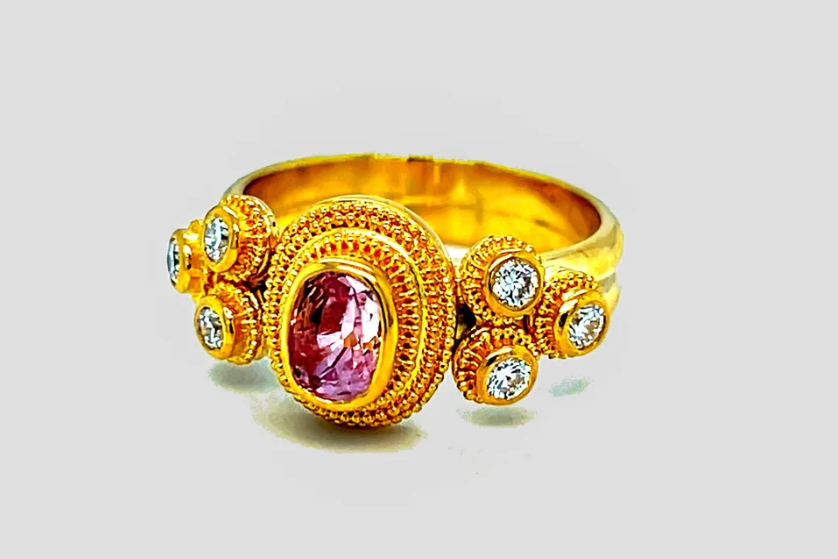
At Luna Felix Goldsmith, handcrafted jewelry reflects a dedication to traditional goldsmithing, one-of-a-kind design, and the artistic character of Santa Fe. The studio works with both 18K and 22K gold and is known for its use of gold granulation, an ancient technique that creates intricate decorative patterns from tiny gold spheres.
For someone considering a custom engagement ring, the design conversation can explore how gold color, gemstone selection, setting construction, and everyday wear should influence the finished piece.
Visit the studio at 116 W. San Francisco Street, Suite 208, Santa Fe, New Mexico, or contact Luna Felix Goldsmith to discuss your ideas.
The right choice is not necessarily the gold with the highest purity. It is the combination of precious metal, craftsmanship, and design that suits the person who will wear the ring.
Authoritative resources
The following resources provide additional background on gold purity and jewelry selection:
Federal Trade Commission — Buying Jewelry. Explains jewelry terminology and consumer considerations, including how precious metals are represented and described.
FTC Jewelry Guides — 16 CFR Part 23. Provides the U.S. regulatory framework for precious-metal quality representations and karat descriptions.
Gemological Institute of America (GIA). Offers educational resources on gemstones, engagement-ring design, settings, and jewelry care.
These references support general jewelry education. The suitability of a particular 18K or 22K engagement-ring design should be determined from its actual alloy, dimensions, and construction.