
Why Are Some Rubies Worth More Than Some Diamonds?
High-quality rubies can be more valuable than some diamonds because exceptional natural rubies are extraordinarily rare. The finest examples combine vivid red color, strong saturation, attractive transparency, substantial size, skilled cutting, limited or no treatment, and respected laboratory documentation.
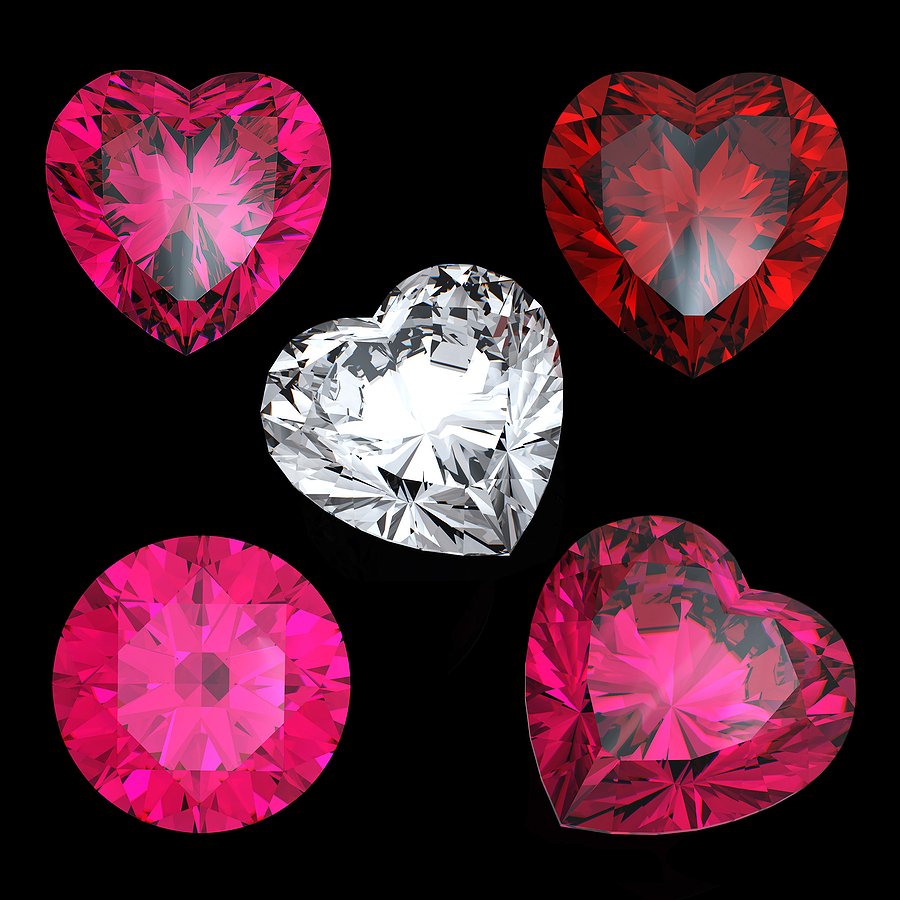
High-quality rubies can be more valuable than some diamonds because exceptional natural rubies are extraordinarily rare. The finest examples combine vivid red color, strong saturation, attractive transparency, substantial size, skilled cutting, limited or no treatment, and respected laboratory documentation.
That does not mean every ruby is worth more than every diamond. Both gemstones exist across broad ranges of quality, rarity, and price. A heavily included or glass-filled ruby may be worth far less than a fine natural diamond. At the same time, an exceptional untreated natural ruby may command more than a smaller, lower-grade, poorly cut, treated, or laboratory-grown diamond.
The meaningful comparison is therefore not simply ruby versus diamond. It is a comparison between two individual gemstones, each with its own color, clarity, cut, carat weight, origin, treatment history, documentation, rarity, and overall visual character.
At Luna Felix Goldsmith in historic downtown Santa Fe, gemstone selection begins by looking at the complete stone. Its name is only the starting point. Its beauty, structure, proportions, treatment, intended use, and relationship with the finished jewelry must all be considered before it becomes part of a handcrafted ring, pendant, necklace, pair of earrings, or heirloom-quality design.
What Is a Ruby?
Ruby is the red variety of corundum, the same mineral family that includes sapphire. Trace amounts of chromium produce ruby’s red color and can also contribute to the stone’s fluorescence.
Gem-quality corundum in colors other than red is generally classified as sapphire. The boundary between pink sapphire and ruby is not always described identically in every market, making accurate identification and transparent representation especially important.
A red gemstone sold as ruby may fall into several different categories:
Natural ruby
Conventionally heated natural ruby
Diffusion-treated ruby
Fracture-filled or lead-glass-filled ruby material
Laboratory-grown ruby
Another red gemstone or simulant incorrectly represented as ruby
These categories may look similar in a photograph, yet they can differ dramatically in rarity, durability, care requirements, and value.
Why Can a Ruby Be More Valuable Than a Diamond?
A fine natural ruby can be worth more than some diamonds because the combination of strong red color, transparency, useful size, attractive cutting, and little or no treatment is extremely difficult to find.
Diamonds also exist across an enormous quality spectrum. The word “diamond” can describe everything from a small commercial stone with visible inclusions and weak cutting to an exceptional natural diamond with extraordinary color, clarity, proportions, and size.
A ruby may exceed a particular diamond in value when the ruby possesses a level of beauty and natural rarity that the diamond does not.
Factors that can elevate a ruby’s value include:
Vivid, attractive red color
Strong saturation
A tone that is neither too pale nor too dark
Good transparency
Limited distracting inclusions
A substantial carat weight
Attractive symmetry and polish
No evidence of heating or only conventional heat treatment
Reliable laboratory documentation
A desirable geographic origin supported by laboratory analysis
Strong collector demand
Exceptional overall beauty
The correct comparison is not between two gemstone categories in the abstract. It is between the complete characteristics of the individual stones.
Rubies and Diamonds Use Different Value Systems
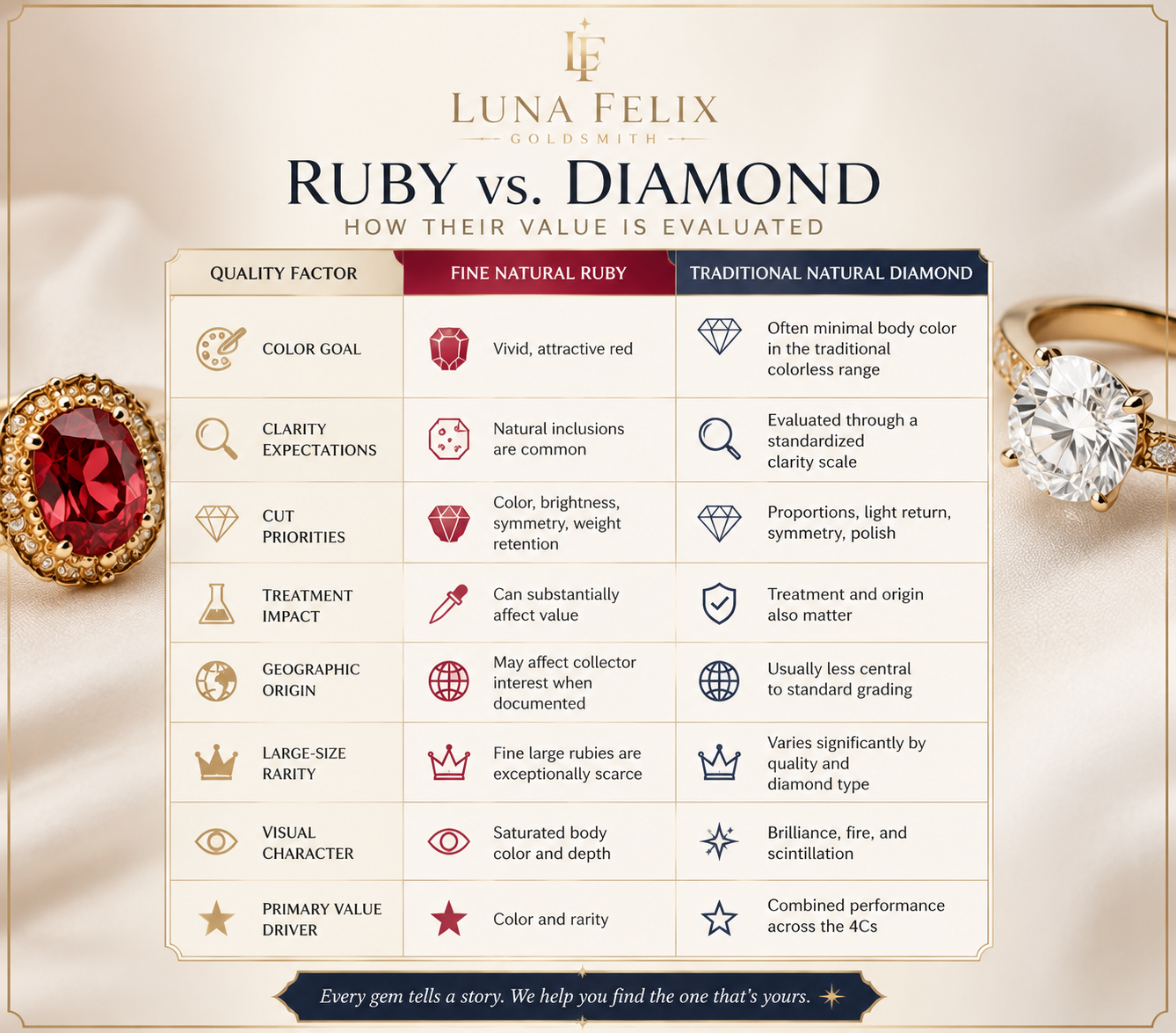
Diamonds are commonly evaluated through the 4Cs:
Color
Clarity
Cut
Carat weight
Rubies can also be discussed through color, clarity, cut, and weight, but those factors do not carry exactly the same importance.
For ruby, color is usually the dominant consideration. A fine ruby should display an appealing red with strong saturation and enough brightness to remain lively under ordinary lighting.
Clarity is also assessed differently. Diamond clarity follows a standardized grading scale. Natural rubies are expected to contain inclusions, so their clarity is evaluated more contextually. The question is not simply whether inclusions exist, but how they affect transparency, beauty, brightness, and durability.
Cut matters for both gemstones. However, a ruby cutter often must balance color, weight retention, symmetry, inclusion placement, transparency, and face-up appearance. Diamond cutting, especially in the round brilliant shape, places more emphasis on standardized proportions and light return.
Why Does Ruby Color Matter So Much?
Color is often the first quality a buyer notices and the strongest influence on ruby value.
Gemstone professionals consider several related characteristics.
Hue
Hue is the dominant color and any modifying color visible in the stone.
A ruby may appear:
Pure red
Slightly purplish red
Orangish red
Pinkish red
Brownish red
Vivid red to slightly purplish red is often highly desirable, although the beauty of the individual gemstone should always guide the final decision.
Tone
Tone describes how light or dark the ruby appears.
A stone that is too light may lack the depth many buyers associate with ruby. A stone that is too dark can lose visible color and brightness, sometimes appearing nearly black in ordinary indoor lighting.
Saturation
Saturation describes the strength or intensity of the red.
A strongly saturated ruby can look vivid and lively. Lower saturation may cause the stone to appear grayish, brownish, or washed out.
Color Evenness
Color may appear evenly distributed or concentrated in bands and zones.
Some natural zoning adds individuality. Strong unevenness, however, may make the face-up appearance less harmonious.
Lighting also changes how ruby looks. Daylight, warm indoor light, jewelry-display lighting, and shadow may reveal different aspects of the same gemstone. Important rubies should therefore be viewed under more than one lighting condition.
What Does “Pigeon Blood Ruby” Mean?
“Pigeon blood” is a trade term associated with certain intensely colored red rubies.
It is not a universal grade applied identically by every gemological laboratory, seller, or market. Different organizations may use different criteria involving hue, saturation, tone, fluorescence, treatment, and origin.
The phrase should never replace a complete examination of:
Actual color
Transparency
Cut
Inclusions
Treatment status
Carat weight
Laboratory findings
Geographic-origin opinion
Overall beauty
A dramatic color name by itself does not establish rarity or value.
How Does Clarity Affect Ruby Value?
Natural rubies usually contain inclusions. A completely inclusion-free natural ruby is highly unusual.
Common internal features may include:
Fine needles or silk
Mineral crystals
Feathers
Fractures
Fingerprint-like patterns
Clouds
Color zoning
Surface-reaching cavities
Some inclusions help trained gemologists confirm that a ruby is natural. Others may provide evidence of heating or another treatment.
The important question is how the inclusions affect:
Transparency
Brightness
Color
Face-up appearance
Structural durability
Treatment identification
A small internal feature that is difficult to see without magnification may have little effect on beauty. A large fracture that reaches the surface can reduce durability and may require a more protective setting.
Ruby clarity should not be judged according to diamond standards. Microscopic perfection is not the expectation for a fine natural colored gemstone.
Why Are Large Fine Rubies So Rare?
As ruby size increases, high quality becomes increasingly difficult to find.
Larger natural crystals are more likely to contain:
Uneven color
Significant inclusions
Fractures
Opaque areas
Unfavorable crystal shapes
Material that must be removed during cutting
A large finished ruby must survive cutting while retaining good color, transparency, useful proportions, and acceptable durability.
Because this combination is so uncommon, value does not necessarily increase in a simple straight line with carat weight. A ruby that weighs twice as much may be worth far more than twice as much when the larger stone maintains comparable quality.
This is also why universal per-carat price claims are unreliable. Treatment, transparency, color, origin, laboratory findings, market context, and individual beauty may create enormous differences between rubies of similar weight.
Does Cut Affect Ruby Value?
Yes. Although color usually leads the evaluation, cutting can strongly influence how that color is displayed.
A ruby cutter must balance:
Color
Brightness
Symmetry
Face-up size
Transparency
Weight retention
Inclusion placement
Durability
Common ruby shapes include:
Oval
Cushion
Round
Pear
Emerald cut
Mixed cut
Cabochon
Antique cut
Freeform shape
A deeply cut ruby may retain more weight but appear smaller from the top. A shallow stone may display a pale or transparent “window” in the center. Strong extinction can cause parts of the ruby to appear dark.
An unusual cut is not necessarily a disadvantage. Custom jewelry allows a setting to be developed around the stone’s actual proportions instead of requiring the ruby to fit a standardized commercial mounting.
How Does Treatment Affect Ruby Value?
Treatment is one of the most important factors to understand when comparing rubies.
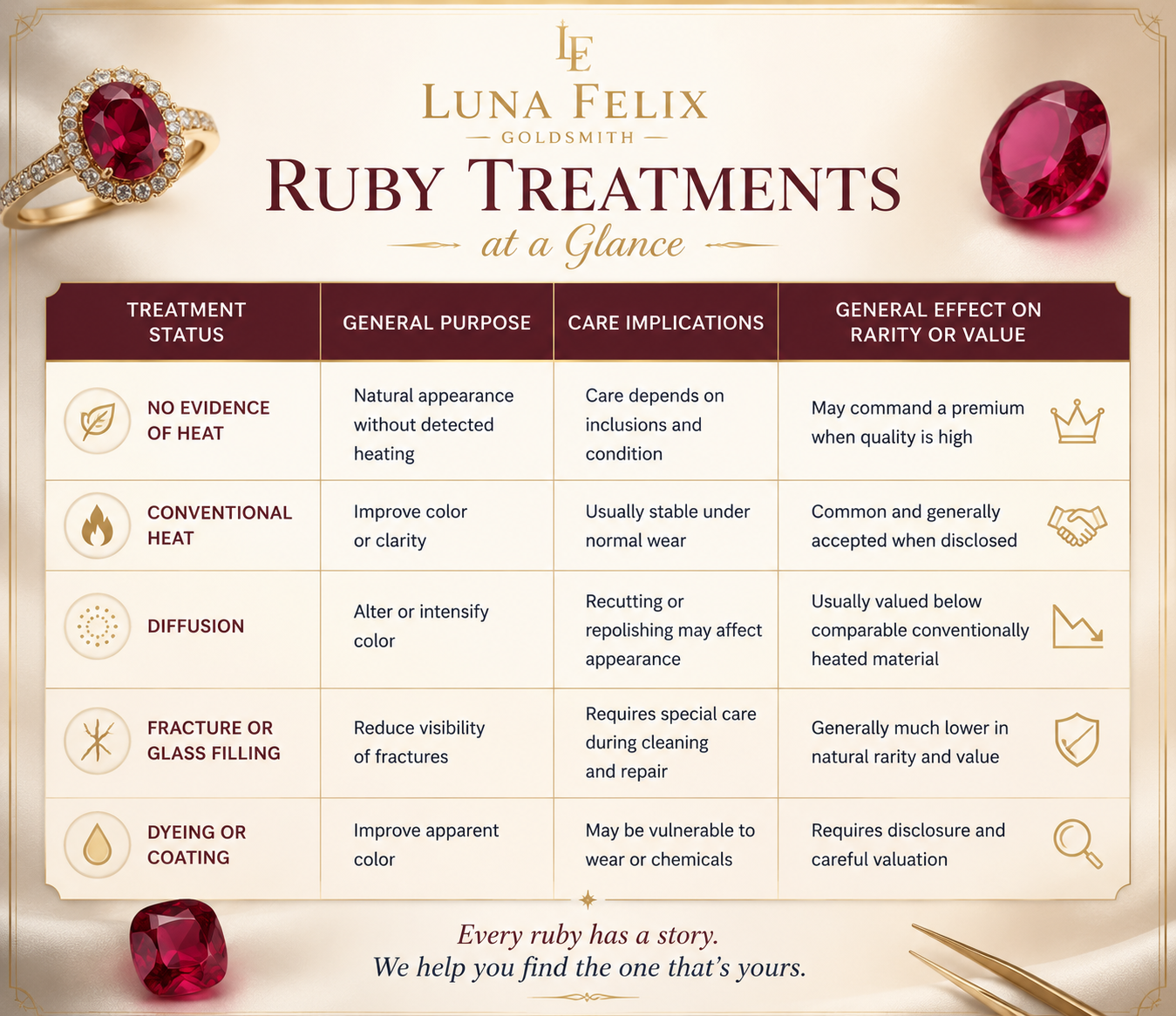
No Evidence of Heat
A respected laboratory report stating that no evidence of heat was detected may add rarity and value.
This does not mean every unheated ruby is beautiful. Color, transparency, cut, size, inclusions, and overall appearance still matter. However, a fine ruby that formed naturally with desirable qualities and required no heating may command a premium.
Conventional Heat Treatment
Heating is common in the ruby market and may improve color or clarity.
A heated natural ruby remains a natural ruby. Heating does not make it artificial, but the treatment should be disclosed.
All other qualities being similar, an unheated ruby may be more valuable because confirmed unheated material is less common.
Diffusion Treatment
Diffusion introduces coloring elements into or near the surface of the stone through heat.
This treatment may create significant color improvement, but it has different implications from conventional heating. Recutting or repolishing the gemstone may alter the appearance when color is concentrated near the surface.
A diffusion-treated ruby should not be represented as equivalent in rarity to an untreated or conventionally heated ruby.
Fracture Filling and Lead-Glass Filling
Fracture filling improves the apparent transparency of heavily fractured ruby material by filling openings with glass or another substance.
The finished material may look much clearer than it did originally, but it has different durability and care requirements.
Glass-filled ruby can be more vulnerable during:
Cleaning
Resizing
Soldering
Polishing
Stone resetting
Jewelry repair
Heat, chemicals, and certain cleaning solutions may affect the filling. A jeweler must know what treatment is present before performing work on the piece.
Dyeing and Coating
Some ruby material may be dyed or coated to intensify its visible color.
These treatments may be less permanent and can create special care requirements. They should always be disclosed clearly.
Does Geographic Origin Affect Ruby Value?
Geographic origin may influence collector demand, particularly when an important ruby has a respected independent laboratory report.
Ruby-producing regions include:
Myanmar
Mozambique
Sri Lanka
Thailand
Vietnam
Madagascar
Tanzania
Other locations
Certain regions carry strong historical associations. However, every mining source produces a range of quality.
A famous origin does not automatically make a ruby:
Vividly colored
Transparent
Unheated
Well cut
Durable
Valuable
Likewise, an exceptional ruby from a less celebrated source may be more beautiful than a lower-quality stone from a famous location.
Origin should never be guessed from a photograph or visual impression. Laboratories examine microscopic features, trace elements, spectroscopy, and reference samples when forming geographic-origin opinions.
Natural Ruby Versus Laboratory-Grown Ruby
Laboratory-grown ruby has essentially the same basic chemical composition and crystal structure as natural ruby, but it is created in a controlled environment.
It should be clearly disclosed as laboratory-grown, laboratory-created, or synthetic.
Laboratory-grown ruby may offer:
Strong color
High clarity
Larger sizes
Predictable availability
A different price range
Natural ruby carries geological rarity that laboratory-grown material does not. The two should not be presented as though origin has no influence on market value.
Either can be visually attractive when represented accurately and chosen knowingly.
Why Do Some Diamonds Cost Less Than Fine Rubies?
The word “diamond” includes an enormous range of gemstones.
A particular diamond may cost less than a fine natural ruby because it has:
A small carat weight
Lower color
Lower clarity
Visible inclusions
Weak cutting
Poor proportions
Damage
Treatment
Limited documentation
Laboratory-grown origin
Greater commercial availability
Lower market demand
A laboratory-grown diamond is a genuine diamond, but its controlled origin and availability differ from those of a natural diamond. This distinction should be explained factually rather than used to dismiss its beauty or suitability.
An exceptional natural diamond can still be worth more than most rubies. The lesson is that quality and rarity must be compared stone by stone.
Are Rubies Durable Enough for Everyday Jewelry?
Ruby ranks 9 on the Mohs hardness scale, making it highly resistant to scratching. Corundum also has excellent toughness and no cleavage, so untreated and conventionally heated rubies are often suitable for frequently worn rings and other jewelry.
However, no gemstone is indestructible.
Durability also depends on:
Inclusions
Fractures
Treatment
Cut
Exposed corners
Setting design
Wearer activity
Maintenance
Glass-filled or heavily fractured rubies may require more cautious handling than untreated or conventionally heated stones.
Frequently worn ruby rings should be inspected periodically for worn prongs, loose settings, impact damage, metal fatigue, and changes in filled fractures.
Why Do Rubies Work So Well in Custom Jewelry?
A ruby rarely behaves like a standardized component. Its exact color, outline, depth, transparency, dimensions, and inclusions influence what the finished piece should become.
A custom design can respond to:
The ruby’s outline and depth
Its strongest face-up color
Vulnerable edges
Inclusion placement
Intended frequency of wear
Complementary accent stones
Metal color
Personal symbolism
The wearer’s style
A ruby may become the centerpiece of:
An engagement ring
An anniversary ring
A pendant
Earrings
A necklace
An heirloom redesign
A collector piece
A commemorative gift
Luna Felix Goldsmith’s custom process may include an initial consultation, gemstone and metal selection, design development, hand fabrication, stone setting, finishing, final inspection, and long-term care guidance. This allows the jewelry to be created around the gemstone rather than forcing it into a predetermined setting.
How Does Gold Color Affect Ruby?
The metal surrounding a ruby changes the way its red color is perceived.
Yellow Gold
Yellow gold adds warmth and can create a rich contrast with red. High-karat yellow gold may emphasize a ruby’s depth and give the design a sculptural, historic character.
Rose Gold
Rose gold creates a closely related warm palette. It may produce a softer, tonal relationship with pinkish-red or purplish-red rubies.
White Gold or Platinum
White metals create cooler contrast and may make the ruby’s red appear more prominent.
High-Karat Gold
Luna Felix Goldsmith works with 18K and 22K gold as well as other precious metals. Their rich color can form a distinctive frame for ruby, particularly when combined with hand-fabricated surfaces and traditional granulation.
Why Does Gold Granulation Complement Ruby?
Gold granulation is an ancient technique in which tiny spheres of gold are fused onto a jewelry surface to create intricate patterns and texture.
Around a ruby, granulation can:
Follow the gemstone’s outline
Form a luminous border
Contrast texture with the polished stone
Add visual depth
Emphasize the warmth of high-karat gold
Connect ancient craftsmanship with contemporary design
The granules are applied to the gold structure, not to the gemstone.
The result can feel both historic and deeply personal: saturated red ruby at the center, surrounded by carefully arranged gold that reflects hours of patient handwork.
What Should You Ask Before Purchasing a Ruby?
Before selecting an important ruby, ask:
Is the ruby natural or laboratory-grown?
Has it been heated?
Has diffusion been detected?
Is it fracture filled or glass filled?
Is there a respected independent laboratory report?
Does the report describe detectable treatments?
Does it provide a geographic-origin opinion?
How does the ruby look in daylight and indoor lighting?
Do any inclusions create durability concerns?
Is the cut attractive when viewed from the top?
Is the setting appropriate for the gemstone?
Which cleaning and repair methods are safe?
What documentation will accompany the purchase?
Clear answers to these questions provide more useful information than an unsupported claim about rarity or a dramatic commercial color name.
Frequently Asked Questions
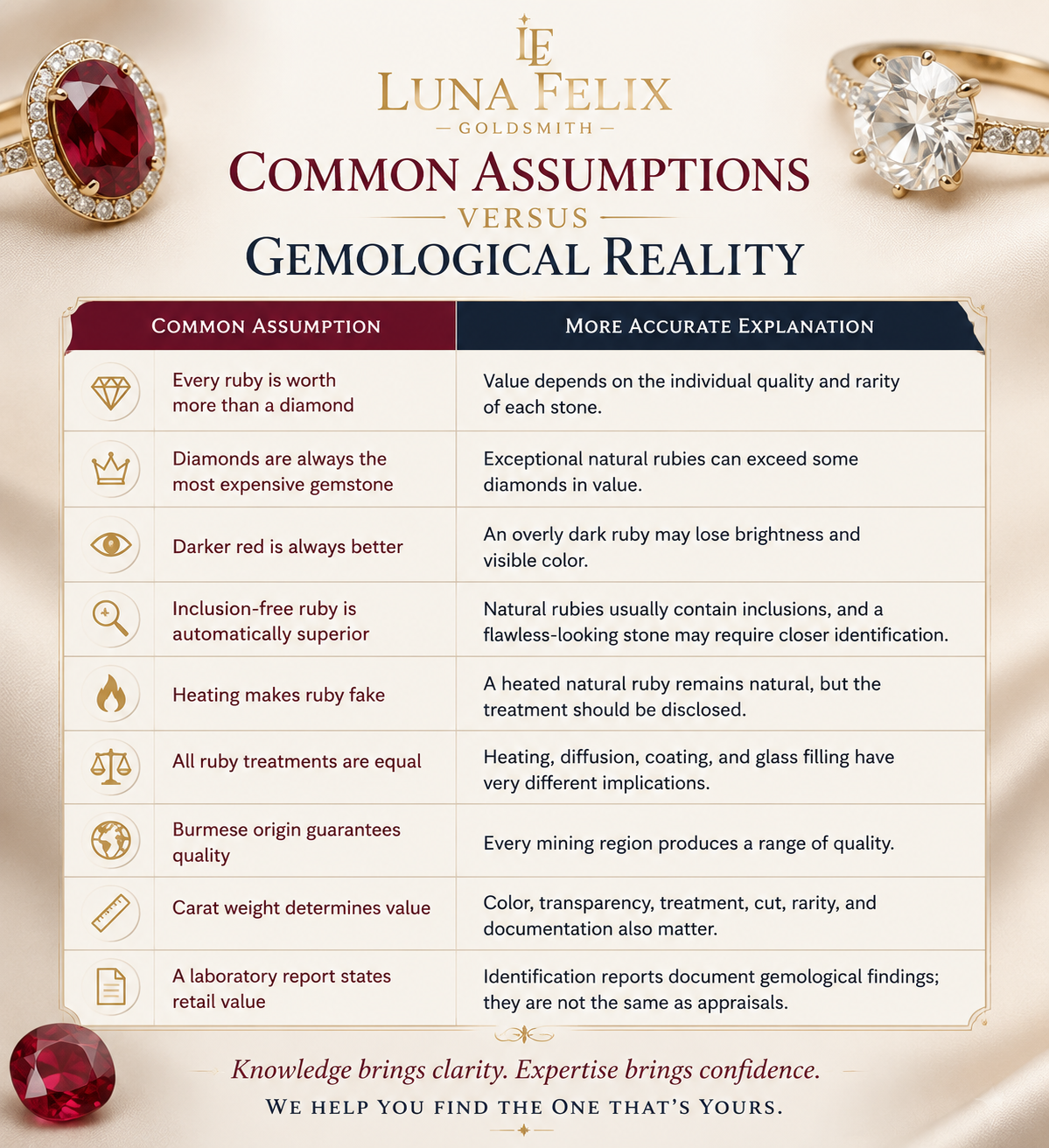
Why can a ruby be more valuable than a diamond?
A fine natural ruby may combine greater rarity, exceptional red color, transparency, substantial size, limited treatment, and strong collector interest. A lower-quality, smaller, treated, or laboratory-grown diamond may therefore cost less.
Are rubies rarer than diamonds?
Fine-quality natural rubies of significant size are extremely rare. Broad comparisons can still be misleading because both rubies and diamonds exist across many quality levels.
Is every ruby worth more than a diamond?
No. Commercial, highly included, glass-filled, or laboratory-grown rubies may be worth far less than fine natural diamonds.
What makes a ruby high quality?
The most important factors include appealing red color, strong saturation, appropriate tone, transparency, good cutting, useful size, limited treatment, durability, and reliable documentation.
What does “pigeon blood ruby” mean?
It is a trade term for certain intensely colored red rubies. Definitions vary, so it should be considered alongside the actual stone and laboratory report.
Are inclusion-free natural rubies common?
No. Natural rubies usually contain inclusions. A flawless-looking stone may require closer gemological examination.
Does heating reduce ruby value?
A heated ruby may be valued below a comparable unheated ruby because confirmed unheated material is rarer. Conventional heating is common and accepted when disclosed.
Is an unheated ruby always better?
No. An unheated ruby may be rarer, but color, transparency, size, cut, inclusions, durability, and beauty remain essential.
What is a glass-filled ruby?
It is heavily fractured ruby material whose fractures have been filled with glass to improve apparent transparency. It has different care, durability, and value considerations from untreated or conventionally heated ruby.
Does ruby origin affect value?
It can, especially when a fine stone has respected laboratory documentation. Geographic origin alone does not guarantee high quality.
Should a valuable ruby have a laboratory report?
For an important purchase, a report from a respected independent laboratory can help establish whether the ruby is natural or laboratory-grown, identify detectable treatments, and sometimes provide a geographic-origin opinion.
Are rubies suitable for engagement rings?
Yes. Structurally sound, untreated or conventionally heated rubies can be excellent engagement-ring stones when properly set and cared for.
Visit a Santa Fe Custom Jeweler for Ruby Guidance
An important ruby deserves to be evaluated as a complete gemstone—not simply by its color name, carat weight, or claimed origin.
Luna Felix Goldsmith combines gemstone selection, custom design, hand fabrication, stone setting, jewelry restoration, high-karat gold, and the ancient technique of granulation within a personal creative process.
Clients can compare rubies under different lighting, discuss laboratory documentation, explore protective setting options, and consider how yellow gold, rose gold, platinum, diamonds, or granulation will affect the finished piece.
To discuss a custom ruby ring, engagement ring, anniversary design, heirloom redesign, or one-of-a-kind gemstone creation, contact:
Luna Felix Goldsmith
116 W. San Francisco Street, Suite 208
Santa Fe, New Mexico 87501
Phone: 505-989-7679
Appointments are recommended.
Conclusion
High-quality rubies can be more valuable than some diamonds because the finest natural rubies represent an extraordinary combination of color, transparency, size, rarity, treatment status, cutting, and documentation.
The comparison should never be simplified into the claim that rubies are always worth more than diamonds. Both gemstone categories span wide quality and price ranges.
For ruby, vivid red color is often the central value factor. Transparency, inclusions, carat weight, cutting, treatment, and laboratory-supported origin may then strengthen or weaken the complete value picture.
Treatments must also be understood clearly. An unheated ruby, a conventionally heated ruby, a diffusion-treated ruby, and a glass-filled ruby may look similar in a photograph while representing very different levels of natural rarity, durability, care, and market value.
The best way to choose a ruby is to look beyond labels. View the gemstone in different lighting, study its laboratory report, ask direct questions about treatment and origin, consider how it will be worn, and choose a setting designed around its precise shape and structure.
When an exceptional ruby is paired with thoughtful design, rich high-karat gold, and patient handcraftsmanship, rarity becomes only one part of its significance. The finished jewelry becomes wearable art—created around the gemstone, the person, and the story it is intended to carry for generations.