How Do Jewelers Create Gold Granulation Jewelry Using Tiny Gold Beads?
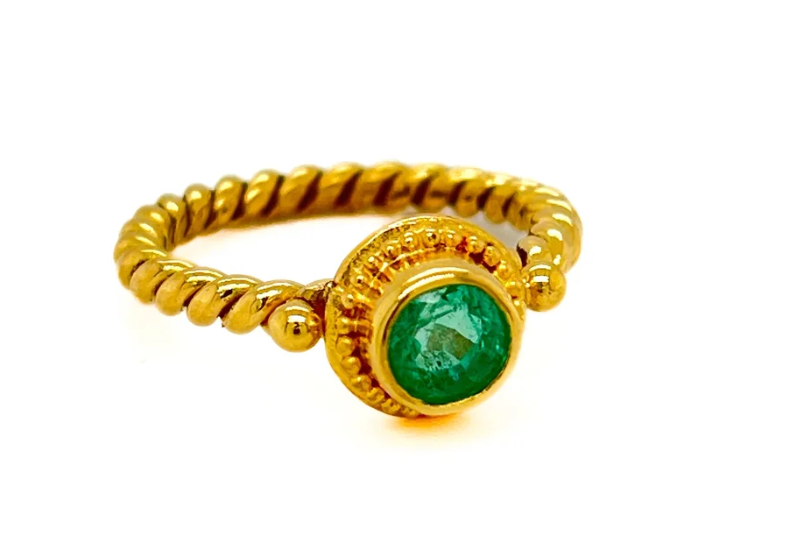
Gold Granulation jewelry work is absolutely beautiful. The thousands of tiny gold balls fused onto gold sheets create mesmerizing works of art. Archaeologists have discovered granulation jewelry on ancient Sumerian pieces dating back to 2800 BC!
But HOW exactly do jewelers create these pieces of artwork? I don’t know about you…but it looks hard (and time-consuming!) to attach hundreds of teeny-tiny beads to gold per square inch!
Wait…didn’t we JUST discuss how soft gold and electrum are?
Well, if gold and electrum (that fancy gold + silver mix we discussed above) are considered soft metals, how did the ancients manage to get those little gold nuggets to not only attach TO the base firmly, but also stay perfectly in place?? Easy! Heat and a little chemistry magic.
Simply put, jewelers cut sheet gold into uniform granules with specialized small-tipped tools. Real magic happens when heat is applied to create powerful bonds between the granules and the jewelry base.
Elbow Grease: Hard Soldering by Hand
Before we talk about the Etruscan methods they used, let’s discuss the most tedious way to attach granules. Brace yourself. It’s called hard soldering.
Essentially the jeweler will use tweezers or a fine paintbrush to pick up and place each granule where they want it to permanently rest. Once in place, the teensy bead is gently pushed into the surface below with slight pressure. This ensures that it won’t budge when dipped in heat.
Next, they take a soldering tip and touch it to where the bead meets the base. The granule and base melt together! Imagine this process for hundreds…maybe even thousands of granules. Oy vey!
No wonder most artisans avoid doing granulation this way.
Yuck: Puddling
Taking it up a notch, granules can be attached using a paste flux mixture. The jewelry artisan coats the base metal with flux and sprinkles granules on top like sprinkles on a cupcake. Then they heat the piece, causing solder in the paste to melt, connecting the granules.
Sounds great…but now you’re left with gross, goopy solder drips all around your beads. That means more work for the jewelry artisan to file and polish the granules free of solder globs. Yuck.
Now this is why the Etruscans were brilliant.
Snuggles: Fusion Bonding Method
Some believe that the talented Etruscans developed a method known as fusion bonding. The key difference between this technique and soldering is that both the base metal and the granules are made from the same alloy of gold.
Jewelry artists brush just enough flux on the base to help the granules stay put after they apply them to the surface. Then the entire piece gets tucked inside a furnace devoid of oxygen. As it reaches the melting point of the gold alloy, the bead magically fuses with the base, right where they make contact.
Since there is no oxygen in the furnace, flux burns away cleanly. You’re left with a perfect bond with no messy solder lines or goopy melted droplets.
Murphy: Colloidal Soldering Technique
Another theory is that the Etruscans were using a technique called colloidal soldering. This technique requires painting on a concoction of gum from plants and copper salts as if it were glue. The gum allows the granules to adhere to the base.
Once in the furnace, the organic material burns away like the flux in the method above. In addition, it leaves behind copper in the areas where granules connect to the base. When the temperature reaches 890°C, copper allows microscopic but mighty strong bonds to form.
This technique works well because it doesn’t take as much heat to granulate, meaning the beads are less likely to melt away before everything solidifies. No matter which technique the Etruscans used, their jewelry skills were next-level awesome.