How Much Should I Spend on a Diamond Engagement Ring?
The answer is refreshingly simple: you should spend an amount that fits comfortably within your financial situation while allowing you to create a ring that reflects your relationship and your partner's personal style. There is no universal dollar amount, no legal requirement, and no gemological standard that says an engagement ring must cost a specific percentage of your income.
Choosing an engagement ring is one of the most meaningful purchases many people will ever make. Along with the excitement often comes one of the most common questions asked by couples preparing for an engagement proposal:
How much should I spend on a diamond engagement ring?
The answer is refreshingly simple: you should spend an amount that fits comfortably within your financial situation while allowing you to create a ring that reflects your relationship and your partner's personal style. There is no universal dollar amount, no legal requirement, and no gemological standard that says an engagement ring must cost a specific percentage of your income.
For decades, many people believed they were expected to spend two or even three months' salary on an engagement ring. While that guideline became widely recognized through advertising campaigns, it should not be viewed as a financial rule or an expectation that applies to every couple. Today's buyers have a much wider range of priorities, lifestyles, and financial responsibilities than previous generations.
An engagement ring should symbolize commitment—not create unnecessary financial stress. Whether your budget is modest or substantial, the goal is to purchase or create a ring that brings joy for decades while fitting comfortably within your overall financial plans.
At Luna Felix Goldsmith in historic downtown Santa Fe, engagement rings begin with education and collaboration rather than sales pressure. Luna Felix works one-on-one with clients to explain diamonds, colored gemstones, precious metals, and handcrafted design options so every ring reflects the couple's priorities instead of an arbitrary spending formula. Every custom piece is individually handcrafted using traditional goldsmithing techniques—including the ancient art of gold granulation—to create heirloom-quality jewelry designed to be treasured for generations.
Is There a Rule for How Much to Spend?
The short answer is no.
There is no law, etiquette requirement, jewelry industry standard, or gemological guideline requiring someone to spend a certain amount on an engagement ring.
The familiar "two months' salary" or "three months' salary" rule originated as a marketing concept—not as financial advice. Today, organizations such as the Gemological Institute of America (GIA) encourage buyers to establish a budget based on their own financial circumstances rather than following a fixed formula.
That approach makes far more sense because no two people have identical financial situations.
For example, two individuals earning the same annual salary may have dramatically different obligations:
Student loans
Mortgage or rent payments
Existing debt
Retirement savings goals
Wedding expenses
Future home purchases
Children
Family responsibilities
Medical expenses
Emergency savings
A ring that feels financially comfortable for one couple might create years of unnecessary stress for another.
Instead of asking:
"How much am I supposed to spend?"
A better question is:
"What amount allows us to purchase a meaningful ring while remaining financially comfortable?"
An engagement ring should celebrate the beginning of a marriage—not become one of its first financial burdens.
Another misconception is that spending more automatically results in a better ring. In reality, craftsmanship, thoughtful design, careful gemstone selection, and personal meaning often contribute far more to a ring's lasting value than simply increasing the purchase price.
A beautifully handcrafted ring featuring an exceptional design and a carefully selected diamond may become far more meaningful than a larger, mass-produced ring chosen primarily because of its price tag.
Questions to Ask Before Setting a Budget
Before looking at diamonds or comparing engagement rings, it helps to establish realistic priorities.
Consider asking yourself the following questions.
How Much Can I Comfortably Spend?
Determine an amount that fits your current financial situation without relying on emergency savings or creating unnecessary hardship.
Your engagement ring should become a source of happiness—not financial anxiety.
Will I Pay Cash or Finance the Ring?
Some buyers choose to pay immediately, while others finance their purchase.
If financing is being considered, review:
Interest rates
Monthly payments
Total repayment amount
Promotional financing terms
Potential deferred interest
Additional fees
Remember that an affordable monthly payment does not always mean the total purchase is affordable.
What Other Financial Goals Do We Have?
Many couples are simultaneously saving for:
A wedding
A home
Travel
Education
Retirement
Starting a family
Building emergency savings
Your engagement-ring budget should complement those priorities rather than compete with them.
What Matters Most to My Partner?
Every person values different aspects of an engagement ring.
Some prioritize:
Diamond size
Exceptional sparkle
Rare gemstones
Handcrafted artistry
Unique design
Ethical sourcing
Custom design
Family history
Personal symbolism
Understanding those priorities helps direct your budget toward features that will matter most over the lifetime of the ring.
Would My Partner Prefer a Custom Ring?
Many couples today enjoy participating in the design process.
A custom engagement ring allows clients to select:
The exact diamond or gemstone
Ring style
Metal
Setting
Decorative details
Personal symbolism
Rather than purchasing a ring from a display case, clients collaborate directly with the artist to create something entirely unique.
Can an Heirloom Stone Be Used?
A family diamond or colored gemstone may become the centerpiece of an entirely new design.
Heirloom stones often carry tremendous sentimental value while creating opportunities for meaningful customization.
Before incorporating an inherited gemstone, however, it should be professionally evaluated for condition, proportions, durability, and suitability for a new setting.
What Should the Budget Include?
Many buyers assume the engagement-ring budget refers only to the center diamond.
In reality, the complete investment may include many different components.
Some of the most common expenses include:
Center diamond or gemstone
Accent diamonds
Ring setting
18K or 22K gold
Platinum
Hand fabrication
Custom design consultation
Stone sourcing
Engraving
Gold granulation
Stone setting
Professional finishing
Laboratory grading report
Sales tax
Jewelry appraisal
Insurance
Ring sizing
Future inspections
Long-term maintenance
Thinking about the ring as a complete work of craftsmanship rather than simply purchasing a diamond helps buyers allocate their budget more effectively.
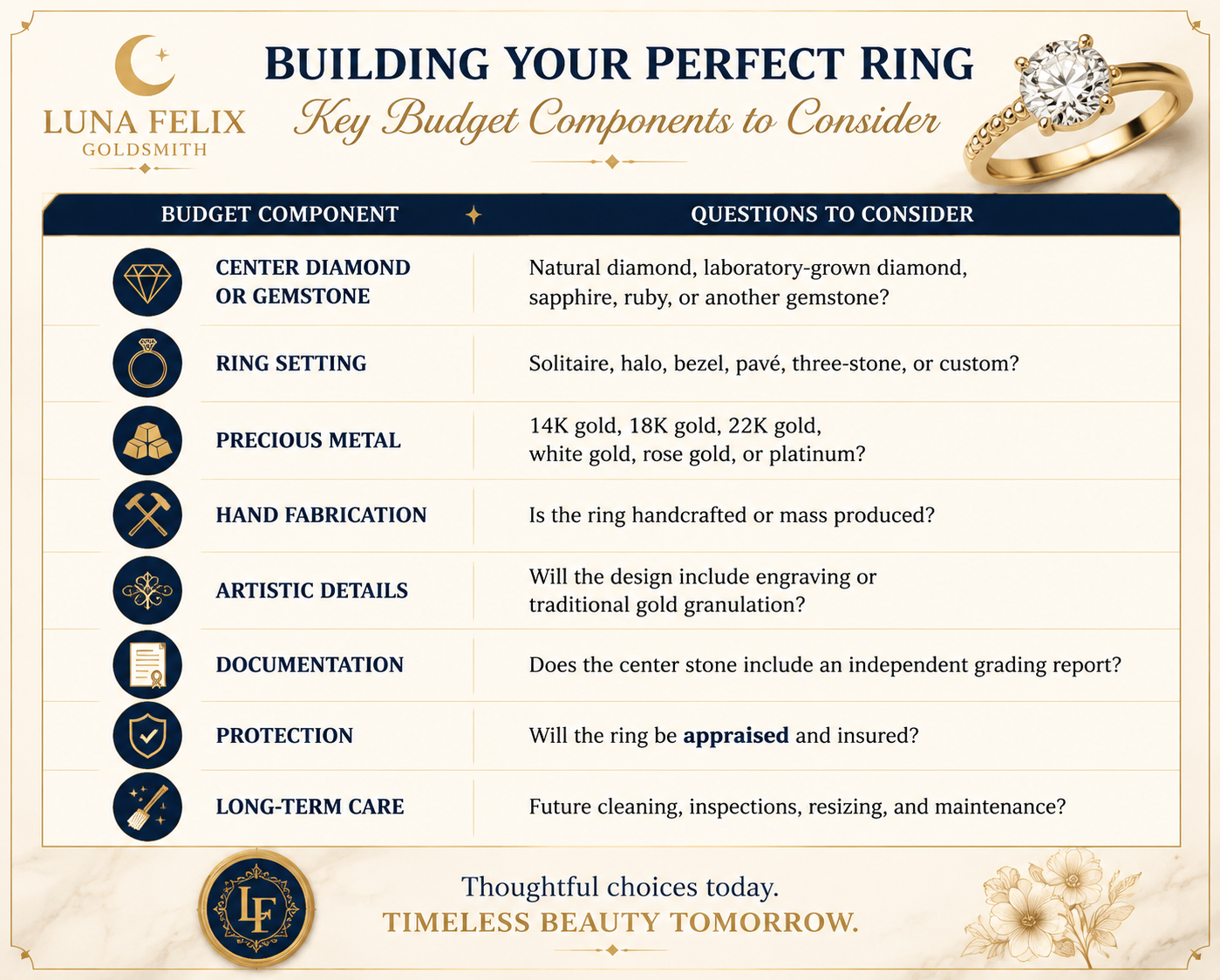
Looking at the complete picture often leads to a more balanced purchase than placing the entire budget into the center stone alone.
How Do Diamond 4Cs Affect Price?
One of the biggest influences on an engagement ring's price is the quality of the center diamond.
The Gemological Institute of America (GIA) developed the internationally recognized 4Cs to help buyers evaluate diamonds consistently.
These four characteristics include:
Cut
Color
Clarity
Carat Weight
Understanding how each factor affects appearance allows buyers to spend more strategically.
Cut
Many jewelers consider cut to be the single most important factor affecting a diamond's beauty.
Cut determines how effectively light travels through the diamond and returns to the viewer's eye, producing:
Brightness
Fire
Scintillation
Overall brilliance
A beautifully cut diamond often appears more lively and visually impressive than a larger diamond with inferior proportions.
Because of this, many buyers choose to prioritize cut quality before maximizing carat weight.
Color
For traditional colorless diamonds, GIA grades color on a scale ranging from D (colorless) through Z (noticeable color).
Higher color grades are generally rarer, but not every buyer needs a completely colorless diamond.
Depending on the chosen setting, especially yellow or rose gold, a slightly warmer diamond may appear just as attractive while allowing greater flexibility within the budget.
Clarity
Clarity measures the presence of natural internal inclusions and external blemishes.
Many inclusions are microscopic and cannot be seen without magnification.
Rather than automatically pursuing the highest clarity grade, many buyers prefer an eye-clean diamond—one whose inclusions are not readily visible during normal viewing. This often provides an excellent balance between beauty and value.
Carat Weight
Carat measures a diamond's weight, not its visible size.
Two diamonds with identical carat weights may appear different depending on:
Shape
Cut proportions
Depth
Table size
Overall dimensions
It's also important to understand "milestone" or "magic" weights such as 0.50, 1.00, 1.50, and 2.00 carats. Diamonds just below these thresholds—such as 0.97 carat instead of 1.00 carat—may offer meaningful savings while appearing nearly identical in size to the naked eye. This strategy can help buyers maximize value without sacrificing visual impact.
Ultimately, the most satisfying engagement ring is rarely the one with the biggest price tag. It is the one that thoughtfully balances the 4Cs, exceptional craftsmanship, meaningful design, and the couple's financial goals to create a ring that will be cherished for a lifetime.
Diamond Shapes
Although many buyers focus first on carat weight, the shape of a diamond has a tremendous influence on its overall appearance, style, and price. Two diamonds with identical weights can look surprisingly different simply because they have different shapes and proportions.
Choosing the right shape is ultimately a matter of personal preference. A ring should reflect the personality and lifestyle of the person who will wear it every day rather than follow current trends or social media.
Some of the most popular diamond shapes include:
Round Brilliant
Oval
Cushion
Emerald Cut
Radiant
Princess
Pear
Marquise
Asscher
Heart
Antique Cuts
Each shape offers its own unique personality.
Round Brilliant
The round brilliant remains the most popular engagement-ring diamond because its facet arrangement is designed to maximize brilliance, fire, and sparkle. It is also typically the most expensive shape on a per-carat basis because of both high demand and the amount of rough diamond lost during cutting.
Oval
Oval diamonds have become increasingly popular because their elongated outline can make the stone appear larger than a round diamond of similar weight while creating an elegant appearance on the finger.
Cushion
Cushion-cut diamonds combine soft rounded corners with larger facets, creating a romantic look that works beautifully in both vintage-inspired and contemporary settings.
Emerald and Asscher Cuts
Rather than emphasizing intense sparkle, these cuts showcase clarity through broad, mirror-like facets. Their architectural appearance appeals to buyers who appreciate understated sophistication.
Pear and Marquise
These elongated shapes can maximize finger coverage and create a graceful appearance while often allowing buyers to choose slightly lower carat weights without sacrificing visual presence.
At Luna Felix Goldsmith, the choice of shape is never made in isolation. The shape influences the setting, precious metal selection, proportions of the finished ring, and even decorative elements such as hand engraving or traditional gold granulation. Every custom engagement ring is designed around the specific diamond rather than forcing the diamond into a standardized commercial setting.
Natural vs. Laboratory-Grown Diamonds
One of the biggest decisions facing today's engagement-ring buyers is whether to choose a natural diamond or a laboratory-grown diamond.
The first thing to understand is that both are real diamonds.
Both possess essentially the same chemical composition, crystal structure, and hardness. To the unaided eye, they can appear virtually identical. Specialized gemological equipment is often required to distinguish one from the other.
The primary difference is how they were formed.
Natural Diamonds
Natural diamonds formed deep within the earth over immense periods of geological time under extraordinary heat and pressure before eventually reaching the earth's surface through volcanic activity.
Many buyers appreciate the rarity and natural history represented by these gemstones.
Laboratory-Grown Diamonds
Laboratory-grown diamonds are created in carefully controlled manufacturing environments using advanced technology that reproduces the conditions necessary for diamond growth.
Although their origin differs, laboratory-grown diamonds are still diamonds—not diamond simulants such as cubic zirconia or moissanite.
Because laboratory-grown diamonds can generally be produced in greater quantities, they often cost less than natural diamonds with similar grading characteristics.
Neither option is inherently "better."
Some couples appreciate the geological rarity and history associated with natural diamonds.
Others prefer the opportunity to purchase a larger or higher-quality laboratory-grown diamond while remaining within their preferred budget.
The most important consideration is transparency.
Reputable jewelers clearly disclose whether a diamond is natural or laboratory-grown so buyers can make informed decisions based on their own priorities.
Rather than encouraging one option over the other, Luna Felix Goldsmith believes clients deserve clear education that allows them to choose the stone that best aligns with their personal values, aesthetic preferences, and financial goals.
Colored Gemstones
Although diamonds have traditionally dominated engagement-ring jewelry, they are certainly not the only option.
Many couples today choose colored gemstones because they reflect individuality, family history, favorite colors, or artistic expression.
Popular engagement-ring gemstones include:
Sapphire
Ruby
Emerald
Spinel
Tourmaline
Aquamarine
Sunstone
Each gemstone offers its own personality and symbolism.
Blue sapphires remain one of the most popular diamond alternatives because of their durability and timeless elegance.
Rubies are admired for their vibrant red color and exceptional rarity, with some extraordinary natural rubies commanding values that exceed many diamonds.
Emeralds display unmistakable rich green color but require thoughtful setting and care because they are generally less durable than diamonds or sapphires.
Some couples even choose combinations, such as:
Diamond center with sapphire accents
Sapphire center with diamond halo
Ruby center with diamond side stones
Diamond center surrounded by colored gemstones
A colored gemstone should never be selected simply because it is assumed to cost less.
Instead, it should be chosen because it reflects the wearer's personality and creates the emotional connection they want their engagement ring to represent.
At Luna Felix Goldsmith, gemstone selection is viewed as part of an artistic collaboration. Color, durability, symbolism, proportions, setting design, and long-term wearability are all carefully considered before the finished piece is handcrafted.
How Does the Setting Affect Cost?
Many buyers focus almost entirely on the center diamond while overlooking the importance of the setting.
The setting contributes significantly to both the appearance and cost of the finished ring.
Common engagement-ring styles include:
Solitaire
Halo
Three-Stone
Pavé
Bezel
Cathedral
Vintage-Inspired
Contemporary Sculptural
Custom Hand-Fabricated
Each style requires different levels of craftsmanship.
A classic solitaire emphasizes the center diamond and often allows buyers to devote more of their budget toward the stone itself.
Halo settings use numerous smaller diamonds surrounding the center stone to increase visual impact while adding additional gemstone-setting labor.
Three-stone rings require carefully matched side stones that complement the center diamond.
Pavé settings involve setting numerous small diamonds into the surface of the ring, creating additional labor and precision.
Custom handcrafted settings often require significantly more artistic planning and fabrication than mass-produced mountings.
Decorative details may further influence the final investment.
These include:
Hand engraving
Filigree
Milgrain
Sculptural metalwork
Gold granulation
Mixed metals
Custom bezels
Rather than selecting a standard mounting from a catalog, Luna Felix Goldsmith handcrafts jewelry around each individual gemstone, creating a harmonious balance between the center stone and the finished design. This personalized approach reflects the studio's emphasis on one-of-a-kind artistry rather than mass production.
Gold vs. Platinum
The metal chosen for an engagement ring influences not only its appearance but also its character, durability, maintenance requirements, and overall cost.
Several excellent choices are available.
14K Gold
Fourteen-karat gold is widely used because it offers durability and versatility while remaining suitable for everyday wear.
18K Gold
Containing a higher percentage of pure gold, 18K gold provides a richer color and luxurious appearance while remaining an excellent choice for fine handcrafted jewelry.
22K Gold
Luna Felix Goldsmith is especially known for creating extraordinary jewelry using rich 22K gold in combination with the ancient technique of gold granulation.
Because of its higher gold content, 22K gold is often selected for artistic, heirloom-quality pieces that emphasize craftsmanship and timeless beauty rather than mass production.
White Gold
White gold offers a bright contemporary appearance and pairs beautifully with colorless diamonds.
Depending on the alloy used, periodic rhodium refinishing may be recommended to maintain its bright white finish.
Rose Gold
Rose gold continues to grow in popularity because of its warm romantic color that beautifully complements many diamonds and colored gemstones.
Platinum
Platinum is naturally white and exceptionally dense.
Its durability, rarity, and heavier weight often contribute to higher material costs.
The best metal depends on:
Personal style
Lifestyle
Desired color
Ring design
Maintenance expectations
Budget
There is no universally "best" choice.
Instead, the metal should complement both the gemstone and the person who will wear the ring.
Why Consider a Custom Engagement Ring?
A custom engagement ring allows the finished piece to become far more than simply a beautiful object.
It becomes a personal story.
Rather than beginning with an existing ring, the design process starts with the individual.
Clients may work directly with Luna Felix to determine:
Preferred diamond or gemstone
Shape
Metal
Ring style
Setting
Surface texture
Decorative details
Personal symbolism
Lifestyle considerations
From there, every stage of the project is carefully developed, including gemstone selection, design refinement, fabrication, stone setting, finishing, and final presentation.
This collaborative process allows each ring to become truly one of a kind.
Heirloom Diamonds
Many families possess diamonds that have been passed from one generation to the next.
An heirloom diamond can become the centerpiece of an entirely new engagement ring while preserving family history and sentimental significance.
Before incorporating an inherited stone into a new design, it should be professionally examined to evaluate:
Overall condition
Chips or abrasions
Existing wear
Structural durability
Measurements
Proportions
Previous repairs
Compatibility with the new setting
Sometimes original accent stones can also be incorporated into the redesigned piece.
Using an heirloom diamond does not necessarily eliminate all costs. Custom design, fabrication, new precious metal, stone setting, finishing, and possible restoration still require skilled craftsmanship.
However, many clients discover that the greatest value lies not in financial savings but in preserving a cherished family legacy while creating an engagement ring that reflects the next chapter of its story.
At Luna Felix Goldsmith, heirloom redesign projects blend traditional goldsmithing techniques with thoughtful contemporary design, allowing treasured family gemstones to continue their journey in a piece of handcrafted jewelry created for generations yet to come.
Spending Strategically
Choosing an engagement ring is not about finding the largest diamond possible or matching someone else's budget. Instead, it's about making thoughtful decisions that maximize beauty, craftsmanship, durability, and personal meaning while remaining financially comfortable.
One of the smartest approaches is to establish your budget before visiting a jeweler. Knowing your comfortable spending range helps narrow your options and keeps the focus on finding the right ring rather than simply the most expensive one.
Many buyers also discover they can stretch their budget by understanding where their money creates the greatest visual impact.
For example, you may wish to:
Prioritize exceptional cut quality over maximum carat weight.
Consider a diamond with slightly warmer color if choosing yellow or rose gold.
Select an eye-clean clarity grade instead of paying for microscopic perfection.
Compare different diamond shapes that may offer greater visual size.
Consider diamonds just below milestone weights such as 1.00 or 1.50 carats.
Explore laboratory-grown diamonds if they better align with your priorities.
Consider durable colored gemstones such as sapphires or rubies.
Invest in custom craftsmanship rather than size alone.
Many buyers are surprised to discover that thoughtful design choices often create a more beautiful engagement ring than simply purchasing a larger center stone.
At Luna Felix Goldsmith, every engagement ring is approached as an individual work of art. Rather than emphasizing a single specification, Luna helps clients balance gemstone selection, metal choice, handcrafted construction, and personal symbolism to create jewelry that reflects the individual who will wear it.
Should You Finance an Engagement Ring?
Some couples choose to finance an engagement ring, while others prefer to save and purchase it outright.
Neither approach is automatically right or wrong. The important consideration is understanding the complete financial commitment before making a decision.
If financing is being considered, review:
Interest rate
Promotional financing period
Deferred-interest provisions
Monthly payment
Total repayment amount
Late-payment penalties
Additional fees
A low monthly payment can make a ring appear more affordable than it actually is.
For example, a ring purchased through financing may ultimately cost considerably more than its original purchase price if interest accumulates over time.
Before financing, ask yourself:
Can I comfortably afford the monthly payments?
Will financing interfere with other financial goals?
Could I purchase a slightly different ring without financing?
Would saving for several additional months reduce financial stress?
The beginning of a marriage should be built upon thoughtful planning rather than unnecessary financial pressure.
Why Does a Diamond Grading Report Matter?
One of the most valuable documents accompanying many important diamonds is an independent grading report.
A grading report describes the characteristics of the diamond, including:
Carat weight
Cut
Color
Clarity
Measurements
Proportions
Polish
Symmetry
Fluorescence (when applicable)
Many buyers choose diamonds that have been evaluated by respected independent gemological laboratories because these reports provide a consistent description of the stone's quality.
It is important to understand that a grading report is not the same as an appraisal.
A grading report identifies and evaluates the diamond.
An appraisal estimates value for a specific purpose, such as insurance.
Understanding the distinction helps buyers make more informed purchasing decisions.
Appraisals & Insurance
After purchasing an engagement ring, many owners choose to obtain both a professional appraisal and appropriate insurance coverage.
Insurance can help protect against losses resulting from events such as:
Theft
Loss
Certain types of accidental damage
Insurance policies differ considerably, so buyers should carefully review:
Coverage limits
Deductibles
Repair provisions
Replacement methods
Scheduled jewelry requirements
Appraisal update requirements
Likewise, appraisals may need periodic updating as precious metal prices and gemstone markets change.
Protecting an engagement ring should be viewed as part of long-term ownership rather than an afterthought.
Common Engagement Ring Budget Mistakes
Even well-prepared buyers occasionally make avoidable mistakes.
Some of the most common include:
Following the Salary Rule
There is no universal amount every person should spend.
Shopping Before Establishing a Budget
Without a realistic spending range, it is easy to become emotionally attached to rings that exceed your financial comfort level.
Focusing Only on Carat Weight
Larger is not always more beautiful.
Cut quality, proportions, and craftsmanship often influence appearance far more than size alone.
Ignoring the Setting
The setting contributes significantly to both the beauty and durability of the finished ring.
Forgetting Additional Costs
Many buyers overlook:
Sales tax
Insurance
Appraisals
Future maintenance
Ring sizing
Assuming Custom Jewelry Is Always More Expensive
Custom jewelry varies widely.
Some handcrafted designs may cost less than comparable designer brands while providing a far more personal result.
Purchasing Without Documentation
When purchasing an important center diamond, independent documentation helps buyers better understand exactly what they are receiving.
Frequently Asked Questions
How much should I spend on a diamond engagement ring?
Choose an amount that comfortably fits your finances while allowing you to create a meaningful ring. There is no universally required budget.
Is the three-month salary rule still recommended?
No. Most experts encourage buyers to establish budgets based upon their individual financial circumstances rather than historical advertising guidelines.
Are laboratory-grown diamonds real diamonds?
Yes. Laboratory-grown diamonds are genuine diamonds with the same basic chemical composition and crystal structure as natural diamonds but are created in controlled environments rather than formed within the earth.
Can I use an heirloom diamond?
Often, yes. A professional jeweler should first evaluate the stone's condition and determine whether it is suitable for incorporation into a new design.
Does custom jewelry always cost more?
Not necessarily. Cost depends upon the gemstone, precious metal, design complexity, craftsmanship, and fabrication required.
Is platinum better than gold?
Neither is universally better. The ideal choice depends upon design preferences, durability requirements, appearance, maintenance expectations, and budget.
Should I insure my engagement ring?
Many owners choose to insure valuable engagement rings to help protect against certain types of loss or damage. Coverage depends upon the specific insurance policy.
Visit Luna Felix Goldsmith in Santa Fe
Selecting an engagement ring should be an enjoyable and educational experience—not one driven by outdated spending formulas or sales pressure.
Whether you're searching for a natural diamond, a laboratory-grown diamond, a vibrant sapphire, an exceptional ruby, or an heirloom redesign, Luna Felix Goldsmith provides personalized guidance throughout every stage of the design process.
Working directly with Luna allows clients to compare gemstones, understand gold, explore handcrafted settings, and create a ring that reflects both the wearer and the relationship it celebrates.
Located just steps from the historic Santa Fe Plaza, Luna Felix Goldsmith has built a reputation for exceptional craftsmanship, artistic vision, and one-of-a-kind custom jewelry featuring our amazing traditional exquisite gold granulation creations.
If you're ready to begin creating a truly personal engagement ring, schedule a private consultation today.
Luna Felix Goldsmith
116 W. San Francisco Street, Suite 208
Santa Fe, NM 87501
Phone: 505-989-7679
Appointments are recommended to ensure dedicated one-on-one design time.
Conclusion
There is no single "correct" amount to spend on a diamond engagement ring.
The best engagement ring is not determined by a salary formula or a specific dollar figure. Instead, it is the one that comfortably fits your financial circumstances while reflecting your partner's personality, your shared values, and your vision for the future.
Every decision—from the diamond's cut, color, clarity, and carat weight to the choice of precious metal, handcrafted setting, and custom details—contributes to a ring that is uniquely yours.
For some couples, that may mean a natural diamond steeped in geological history. For others, it may involve a laboratory-grown diamond, a vibrant sapphire, a rare ruby, or a cherished heirloom gemstone redesigned into a new heirloom. The right choice is the one that best aligns with your priorities, lifestyle, and story.
At Luna Felix Goldsmith, every engagement ring begins with education, collaboration, and exceptional craftsmanship. By working one-on-one with an experienced Santa Fe goldsmith, you can confidently create a handcrafted engagement ring that honors your budget, celebrates your relationship, and is designed to be treasured for generations to come.