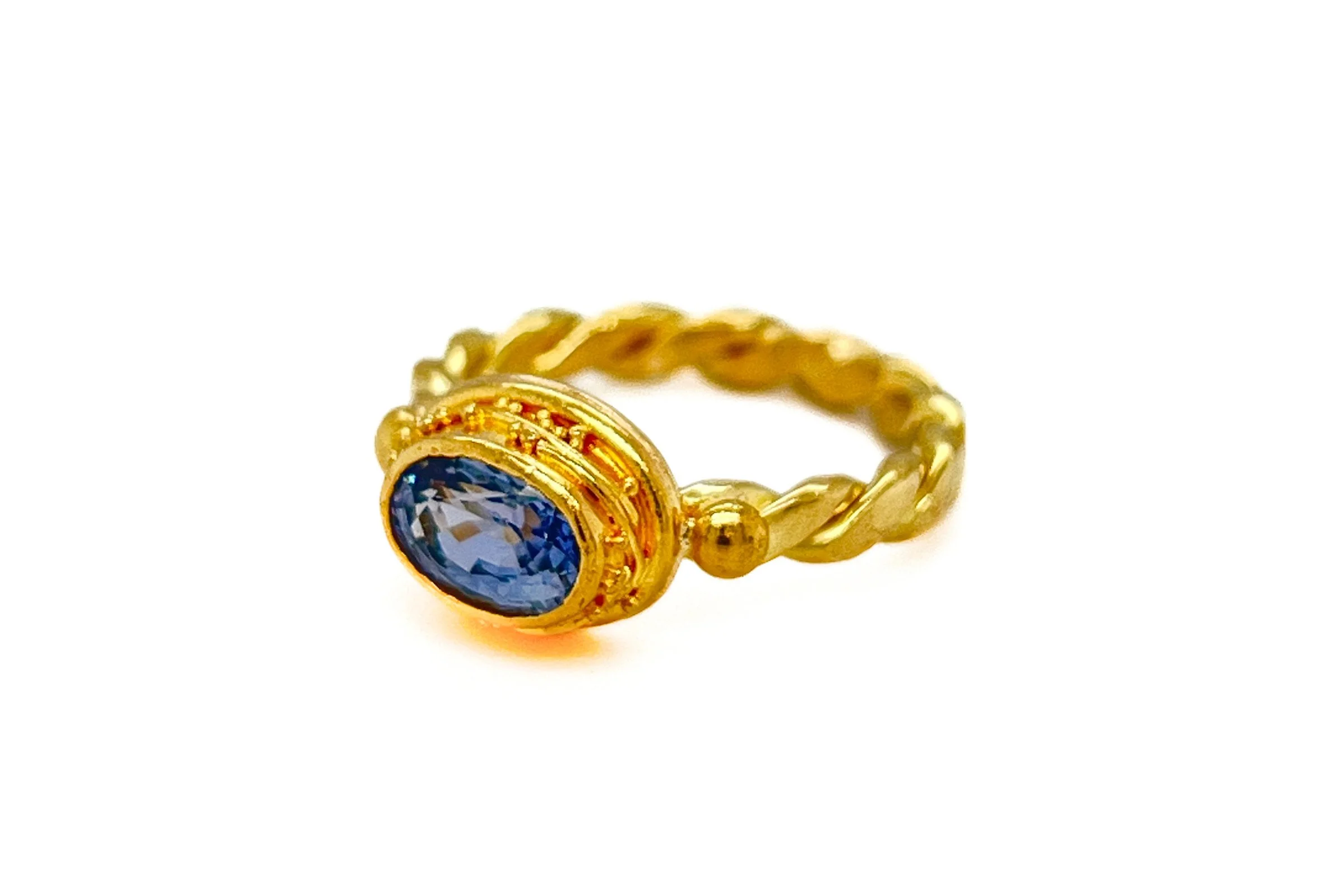
What Are The Basic Facts About Gold Granulation Jewelry?
If you would like to learn how to design your own custom granulation jewelry, schedule a time for a one-on-one meeting in house with our owner and founder Luna Felix of Luna Felix Goldsmiths one of Santa Fe's top custom jewelers.
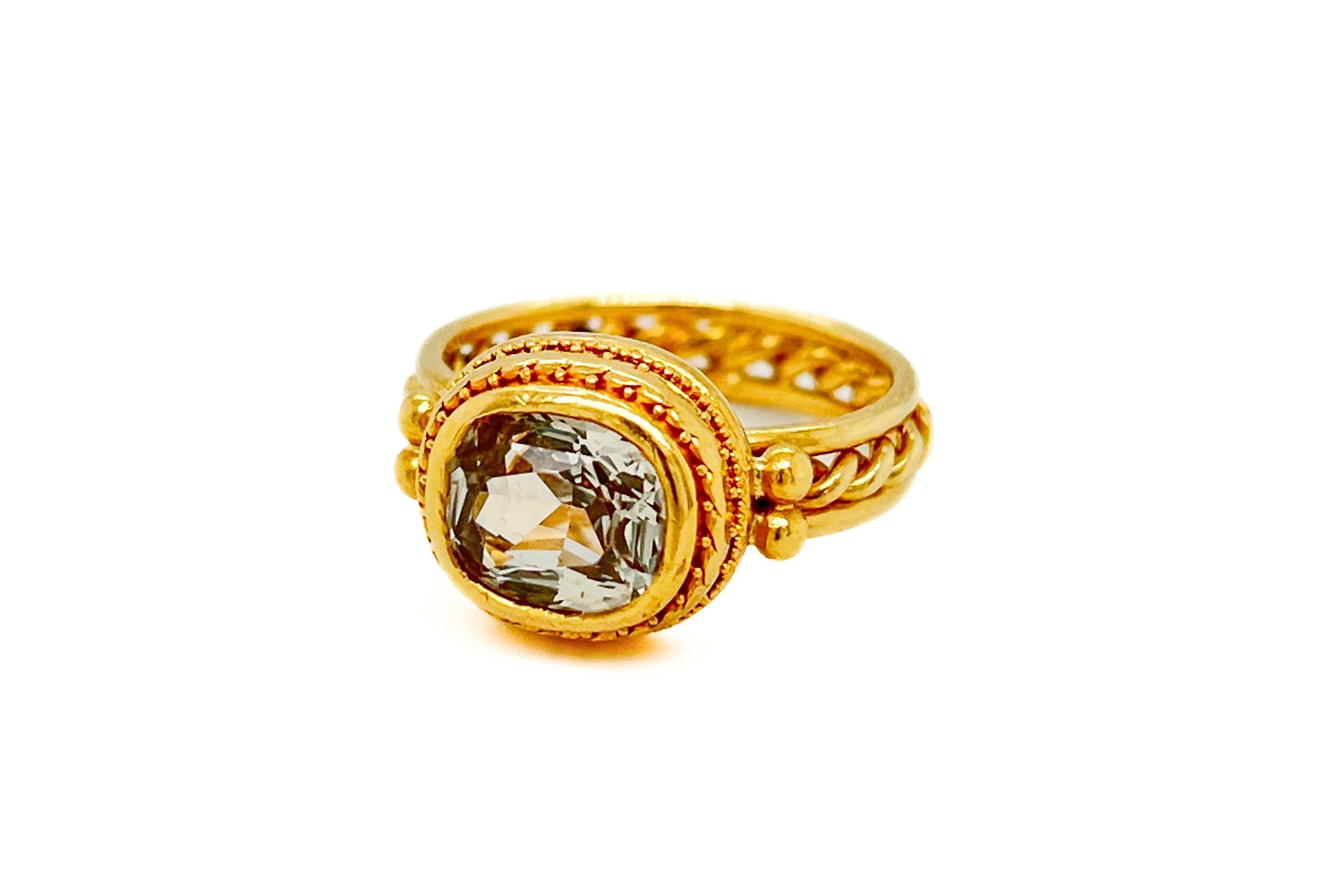
One of the oldest jewelry making technique is granulation. This is the technique of joining tiny gold beads together to create texture, depth and dimension in fine jewelry -adding beauty and allure to a piece but also turning it into wearable art.
Like hand milgrain, hand engraving and fine filigree, this is one of the types of specialized craftsmanship of the artisans at Luna Felix Goldsmith which is quite adept at producing custom rings and gemstone jewelry items.
If you would like to learn how to design your own custom granulation jewelry, schedule a time for a one-on-one meeting in house with our owner and founder Luna Felix of Luna Felix Goldsmiths one of Santa Fe's top custom jewelers.
Give us a call at 505-898-7679 to talk about the piece of jewelry you'd like to create, or stop by our shop in downtown Santa Fe, NM.
The Origins of Granulation
Granulation is the ancient art of soldering minute gold beads on to jewellery has its origin as long ago as 2500 BCE with Sumerian culture in Mesopotamia.
These ancient artisans made incredibly beautiful, complex patterns that still impress modern jewellers.
Egyptians eventually gained notoriety for granulating jewel — neckbands, sprucing up gems, and hoops — made with the most extreme accuracy which much of the time consolidated religious pictures like the Eye of Horus.
Over time, granulation spread to other civilizations. In fact, the middle level of that chart is in Italian, where we find one of the great Etruscan cultures (8th-3rd centuries BCE).
Their jewelry typically included geometric patterns, floral designs and animal motifs. Their artwork was far more than just aesthetically pleasing, these were pieces that denoted wealth, status and spiritual belief; the Etruscans placing a great deal faith in fate as dictated by the will of the gods
Granulated Designer Jewelry by Luna Felix Goldsmith
How Granulation Works
Manufacturing granulated jewelry is a very tedious process and it needs skill and patience. Golden granulation, a method of adding tiny gold beads (granules) onto the surface of an ornament to create patterns.
Craftsmen employ special tools and techniques to add granulation Aided by tweezers, pliers and sometimes even hammers to put the granules in place, heat is then gently applied through processes like torching/ laser fusion.
In the past, granules have been fire welded with a mixture of copper salts (a bonding agent which melts at a lower temperature than the gold and permits the granule to join without it being in its molten state). More recently, jewelers have applied the use of soldering or more precise heat control methods.
They are usually produced by snipping off pieces of gold wire, which are joined before being heated until they turn into balls. The design is set up, then the granules are fused on the surface according to trend.
Granulation vs. Milgrain
Granulation is often confused with hand milgrain, because both are ancient techniques of the artisan. Granulation is the technique of placing small beads of metal (usually gold) onto a surface to partition areas for patterns and designs in jewelry.
Using heat or a bonding agent, the beads are more often than not fused to the piece — sometimes in a layer over broad surfaces that must be carefully bonded together without melting from one side.
Milgrain, however, refers to small metal bumps that line the outer edges of a piece of jewelry. Using a beading tool or engraving, this process involves making small metal bumps at regular intervals along the perimeter of the jewelry piece.
The term milgrain, which literally means a thousand grains, caught on during the 20th century with the advent of the Edwardian and Art Deco periods. It is often used along the perimeter of a design, giving the piece an elegant but understated border without overshadowing the central motif.
Although granulation and milgrain each have their own unique visual features, granulation is about texture and (usually) intricacy where milgrain can be seen as a more refined or ornamental matte that highlights the curves of the jewelry.
Ottonian ring, 10th century German, with cloisonné-ornamentCentral-EuropeRing(c. 1000).
Styles and Variations of Granulation
Etruscan jewelry of the past was created and made so interesting — rows of tiny little beads positioned perfectly to form geometric shapes or flowers or even animals.
The Egyptian granulation probably was a little more organic. They combined nature and celestial symbols with patterns, along with granulation which was effective when mixed with other media (lapis lazuli or turquoise) to make the gold beadwork more circumscribed.
Whilst the Greeks and Romans had been inspired by earlier cultures such as the Etrucians, Egyptians etc., they used granulated gold in a more simple yet refined manner-having granules in very small areas (as details), rather then over much of the surface. You will find it in earrings, pendants with few beads enough to stand against by reigning smooth gold.
Granulation has been part of complex filigree designs in India and the Islamic world, where thin gold strands are combined with granules. Indian granulated jewelry is frequently very flowy and light, with practically lace-like detail that catches the eye of light along with shimmers.
Modern-day granulation, however, has evolved this ancient technique by combining it with current advancements in jewelry tools. Still, the laser technology is only used by some with others reverting back to traditional building style such as hand-fusing granules rather than utilizing soldering.
Jewelry designers are venturing into more bold and abstract styles. This could be part of a larger composition that plays with texture, or even something more minimal where a few individual grains are placed to create a delicate look.
The Value of Granulated Jewelry
Much like any fine jewelry that is hand engraved, milgrained and filigree, granulation is not only valued for its appearance but also the craft needed.
Each piece is, in fact, a masterpiece due to the laborious work of fusing minuscule gold beads together painstakingly on any given surface. To make matters even more captivating, the methodology itself has a fascinating history in culture.
Luna Felix Goldsmith is both a custom jeweler and a Santa Fe jewelry store. If you want to design your own jewelry with granulation, feel free email us at our Santa Fe custom ring store that practices a no-touch worry policy.
Call Luna Felix Goldsmith today at 505-989-7679 to leave a message. You can also contact us via email by using the contact form below.

Top 20 Stunning Jewelry Showcase Pieces from Luna Felix Goldsmith - Part 4
In the final part of our series, we explore more of Luna Felix Goldsmith’s breathtaking rings, each one a testament to the brand’s dedication to quality and artistry
In the final part of our series, we explore more of Luna Felix Goldsmith’s breathtaking rings, each one a testament to the brand’s dedication to quality and artistry. Some of the jewelry pieces listed in this four-part articles’ series are part of Luna Felix Goldsmith’s Custom Orders and one-of-a-kind pieces and are not available for sale. They are listed here to present what jewelry designer Luna Felix is capable of designing.
16. Topaz Ring
This ring features a stunning topaz stone, offering a fresh and vibrant look. The stones are set in a delicately crafted gold band, perfect for adding a touch of elegance to any outfit.
17. Diamond Ring
A diamond creates a classic and sophisticated ring. The gold band’s intricate design adds to the overall elegance, making it a timeless piece.
18. Garnet and Opal Ring
Combining the deep red of garnet with the unique play of colors in opal, this ring is both bold and beautiful. The stones are set in a gold band with detailed craftsmanship, reflecting Luna Felix’s dedication to quality.
19. Sapphire and Diamond Ring
A stunning sapphire surrounded by diamonds creates a luxurious and elegant ring. The gold band’s intricate detailing enhances the overall beauty, making it a must-have for those who appreciate fine jewelry.
20. Aquamarine Ring
Featuring a mesmerizing aquamarine stone, this ring is a perfect blend of elegance and sophistication. The gold band’s craftsmanship highlights the stones’ beauty, making it a standout piece in any collection.