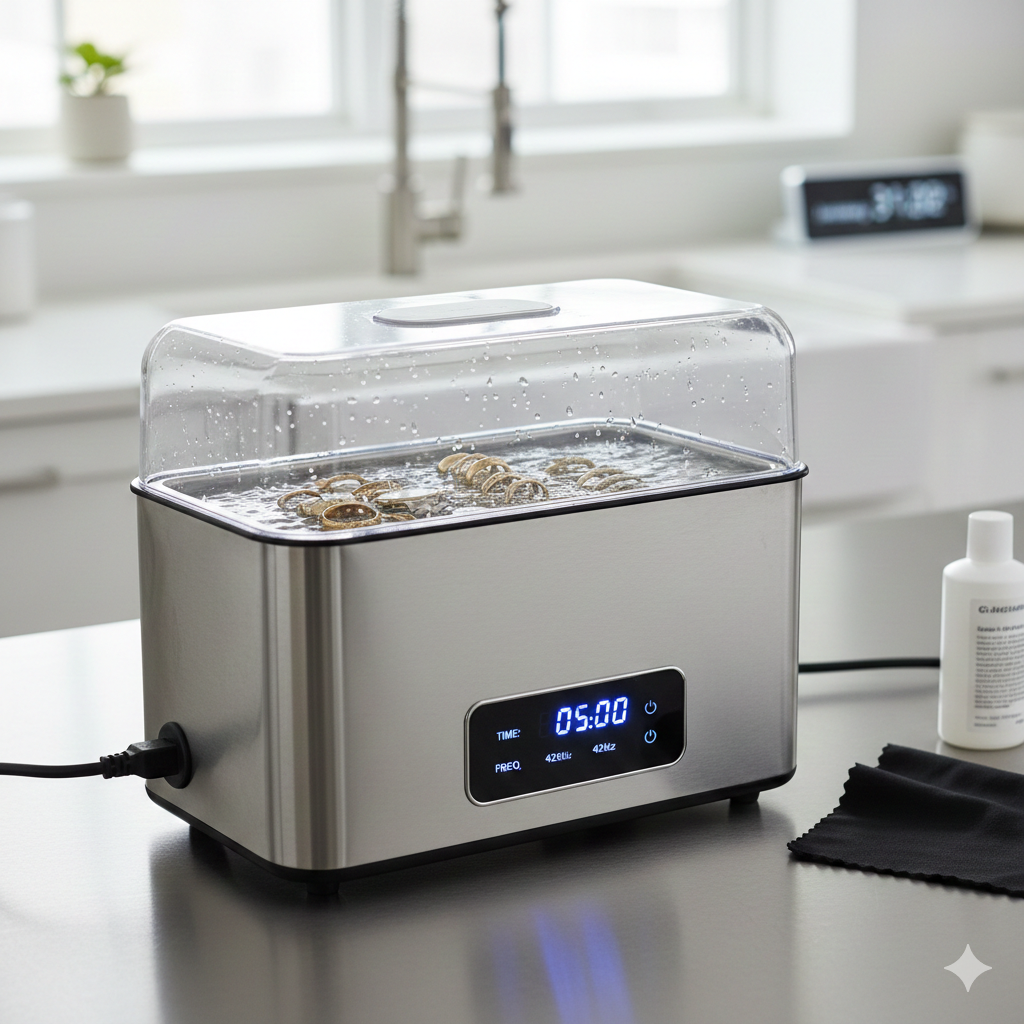
Can You Clean Gemstone Jewelry in an Ultrasonic Jewelry Cleaner?
You've probably watched countless videos of people cleaning their jewelry with ultrasonic cleaners—it looks easy and tempting to try. But don't be fooled: not all gemstone jewelry is safe for ultrasonic cleaning. The specific gemstone, metal type, and jewelry setting can make ultrasonic cleaning risky and may damage your pieces.
In this article, we will examine whether ultrasonic cleaners are safe for your gemstone jewelry by analyzing key factors, including gemstone hardness, cleavage, structure, and setting style.
You've probably watched countless videos of people cleaning their jewelry with ultrasonic cleaners—it looks easy and tempting to try. But don't be fooled: not all gemstone jewelry is safe for ultrasonic cleaning. The specific gemstone, metal type, and jewelry setting can make ultrasonic cleaning risky and may damage your pieces.
In this article, we will examine whether ultrasonic cleaners are safe for your gemstone jewelry by analyzing key factors, including gemstone hardness, cleavage, structure, and setting style.
How does Ultrasonic Cleaning work?
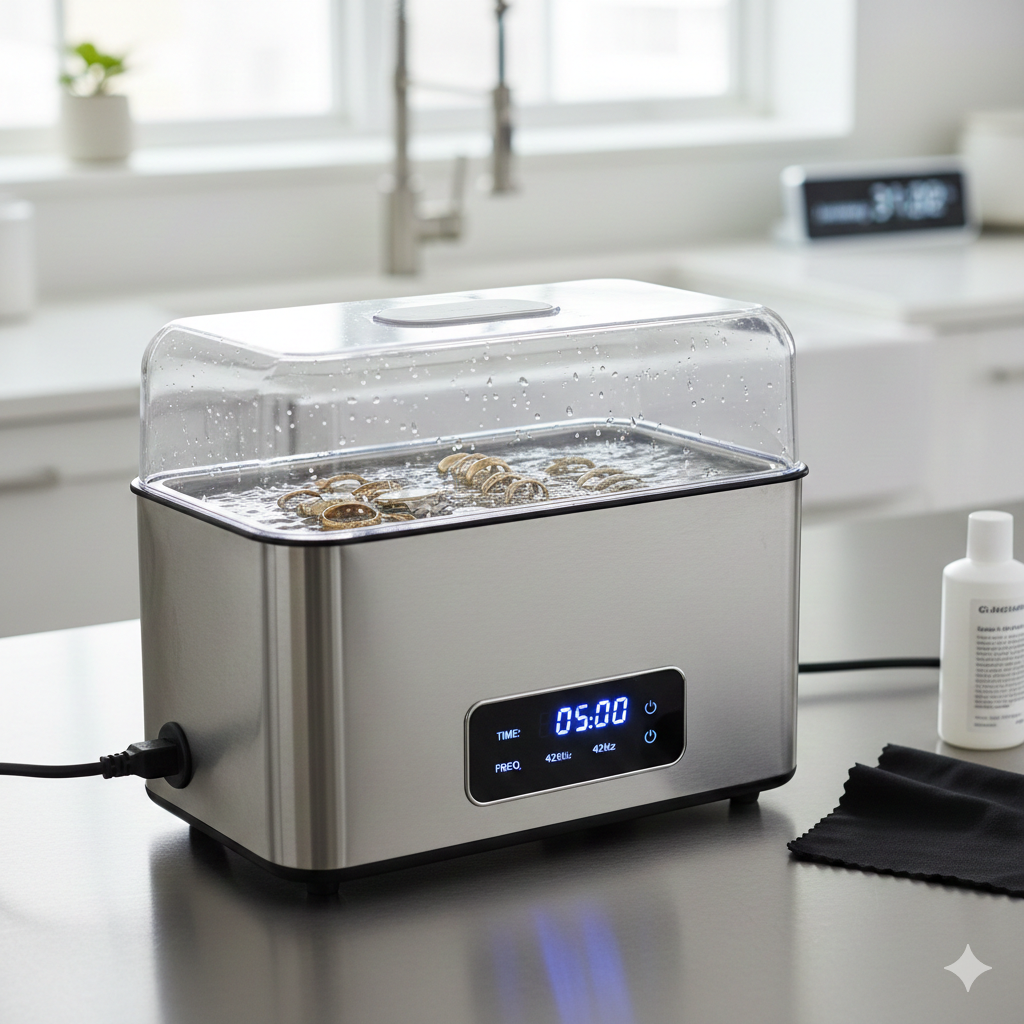
For those of you who don’t know, let’s take a moment to explain how these magical machines work. Ultrasonic cleaners work by generating high-frequency sound waves in water. These waves create microscopic bubbles that continuously expand and collapse, a phenomenon known as “cavitation”. The force of this operation effectively removes dirt, oil, and debris from your jewelry at the surface and deep into the little crevices your eyes can’t see.
Factors Determining If You Can Clean Gemstone Jewelry in an Ultrasonic Cleaner
Hardness
Hardness is defined as a gemstone’s resistance to scratches and abrasion. In gemology, we determine hardness using the Mohs scale, with 10 being the highest possible rating. Here’s a general guide for gemstone hardness:
Hardness
· High (>7)
· Medium (5-7)
· Low (<5)
The higher the hardness rating, the greater the gemstone's durability. So, when thinking about which gems you can clean in your ultrasonic cleaner, many people assume that a higher hardness rating means it's safe to clean. This is untrue. While hardness determines how easily your gemstone scratches on the surface, it does not necessarily indicate how resistant it is to breakage.
When you clean your jewelry in an ultrasonic cleaner, it will not only create friction on the surface of your gemstone but also cause it to wear down. The ultrasound will also send vibrations through the stone's body. That is why, when discussing whether you can put a gemstone in an ultrasonic cleaner, we also have to talk about toughness.
Toughness is a gemstone's resistance to breakage or fractures. Factors that affect toughness are cleavage and structure. Let’s talk about those two below.
Gemstone Cleavage
Gemstone cleavage refers to the tendency of a mineral crystal to split along defined crystallographic directions when subjected to an external force. Cleavage planes are directions in a crystal where atomic bonds are weaker, causing the mineral to break smoothly along those directions. The newly exposed surface will be smooth and flat because the atomic bonds pulling those ions together are weaker in that direction of the crystal structure.
You can think of cleavage as the identification of the weak layers within a gemstone. All gemstones have some level of cleavage that is generally rated as follows:
· Perfect Cleavage: Gem can split easily along certain directions, with resulting surfaces being very smooth and flat.
· Good Cleavage: Gem has a tendency to split along certain directions, with resulting surfaces being relatively smooth.
· Fair Cleavage: Gem can split when pressure is applied, but is unlikely to do so. Any resulting surfaces will be very uneven.
· Imperfect Cleavage: Gem does not like to split along certain directions, but when pressured strongly enough, it will show signs of splitting.
· No Cleavage: Gem will break unevenly. This is known as a fracture.
Since ultrasonic cleaners can produce such a large force in such a small area, they have the potential to make existing cracks larger, create new fractures inside the gemstone, or completely shatter the stone. For these reasons, we do not recommend cleaning gems with perfect or good cleavage in an ultrasonic cleaner. Of course, you should also consider this alongside other factors, such as hardness, but it is a good place to start.
Gemstone Structure
Structure refers to how the internal structure of a gemstone’s crystals is formed. For example, is it porous? Does it have layers? Structure can tell you a lot about a gemstone's integrity and whether it has cracks, inclusions, or other internal flaws.
A porous structure will absorb water while in the ultrasonic cleaner. This can weaken the stone due to its internal voids and cause microcracks on the surface as trapped water evaporates.
Layered stones are prone to peeling or fracturing when vibrated by high-frequency sound waves.
Cracked stones or stones with fragile inclusions can suffer from increased fracturing or localized damage.
Even if a gemstone has high hardness and no cleavage, a loose or porous structure with cracks or inclusions remains unsafe for ultrasonic cleaning. The gem's physical condition, not just its hardness, dictates its vulnerability to ultrasonic damage.
Insight: Keep in mind that such a structure is what dictates hardness and cleavage. The gemstone's structure ultimately determines its physical properties.
Gemstone Treatments
Although the majority of gemstones don’t undergo any changes from when they are mined to when you buy them, some gemstones are treated to improve their appearance. Treatments can include irradiation, heat, or even oils. One common treatment is with emeralds. Emeralds are often treated with oil to fill in the many cracks that are characteristic of emeralds. Oiling helps make the emerald appear softer and more refined. Gemstones can even be treated with heat or irradiation to boost their color.
As a general rule, we do not recommend putting treated gemstones in an ultrasonic cleaner, as it can damage the stone or undo the treatment. When you buy gemstone jewelry, you can always request that the jeweler give you a gemstone report/gemstone certificate. Most gemstone certificates list whether the gemstone has been treated.
Setting Style and Condition
The gemstone's setting style is also very important when determining whether you can clean your jewelry in an ultrasonic cleaner. Settings that provide greater protection for the gemstone, such as a bezel or channel, will absorb more vibration and minimize damage to the precious stone. Settings with less protection, such as prongs, can leave your gemstone more susceptible to impact.
You should also consider whether your jewelry is in good condition. If your jewelry is already loose or damaged, you should not put it in an ultrasonic jewelry cleaner, as the vibrations can cause the stone to dislodge.
Metal Type
Sterling silver, gold (K gold), and platinum jewelry are safe to clean in an ultrasonic cleaner.
Exception: Do not clean gold-plated jewelry in an ultrasonic cleaner. The layer of gold on gold-plated jewelry is incredibly thin (less than 0.5 microns). Putting it in an ultrasonic cleaner can cause it to peel, bubble, or discolor. This also goes for white gold. Most white gold jewelry sold is rhodium-plated. Unless your white gold jewelry is not plated, do not put it in an ultrasonic cleaner.