What is the Origin of the Precious Gemstone Sapphire?
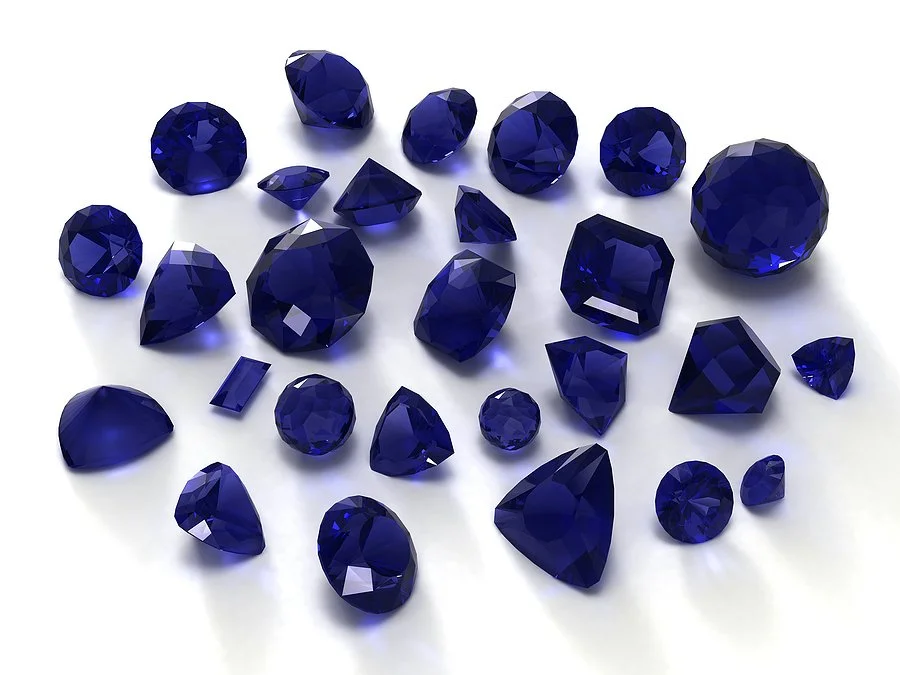
Although no one knows for certain, scientifically or otherwise, how long-ago Sapphire gemstones formed, we do know that sapphires found today formed approximately 150 – 200 million years ago. Where sapphires are found today gives us clues and indications to where and how they formed as jewelry worn by people around the world.
Historical Facts About Sapphire
The word Sapphire derives from the Greek word “Sapphires”, meaning blue. Blue is the color of Sapphire gemstones most commonly found in jewelry. The colors range from pale ice blue to a deep vivid cobalt blue, but did you know that Sapphires also come in other colors?
Blue Sapphire is just the most desired variation of the mineral Corundum. Sapphire also comes in orange-pink, golden, white, and yes even black. Sapphire in its natural crystal form is known as a trigonal (3-sided prisms).
Take a look at this interesting Sapphire variation with Rutile (source form of titanium) intrusions within the crystal. This causes the light to refract or bounce off in what is called a six-point star. A stone like this is referred to as a Star Sapphire.
This Star effect is also known as Asterism and is considered a less desirable (impure) form of Sapphire.
All colors of the transparent variety of mineral Corundum are known as Sapphire. Large deposits of quality sapphires are only found in a few countries throughout the world. Mainly located in southern Asia and eastern Africa. The islands of Sri Lanka (also known as Ceylon) and Madagascar produce the majority of quality sapphires in the world.
How are Sapphire Gemstones Formed?
Where did Sapphire Gemstones come from? What happened inside the earth to create these beautiful gems and bring them closer to the surface? That answer varies from country to country, but the process is the same.
Sometime in ancient world millions of years ago source rocks deep within the earth were put under tremendous pressures, with intense high temperatures. This caused the atoms in the rock to break down and recombine into new metamorphic rocks (changed from its original form). The new metamorphic rock included gems such as Rubies and Sapphire (Corundum).
How do sapphires form in nature?
In each country, this process can vary slightly. Some Sapphires are formed inside high-grade metamorphic rocks and igneous rocks know as gneisses and granulites. Locations of these types of rocks are found in Australia, Sri-Lanka, India, Madagascar and Eastern Africa.
Most Sapphires formed between 6–18 miles down into the earth’s crust. The immense pressures from above, and high temperature above 800 degrees Fahrenheit changed sedimentary (“layered water deposited” rocks). Examples of these rocks are Siltstone and Shale.
Geological Formation Process
Sapphires are formed by the movement of our planet. Earthquakes, lava flows, mountains being formed, volcanic eruptions, you name it. All these cause shifts in the earth’s crust.
Sapphire Gemstones are formed by certain movements of heat and pressure and are found in both metamorphic and igneous rocks. Rocks that have Sapphires in them are granite, schist, gneiss, nepheline syenite to name a few.
They are also found in deposits of alluvium.
When Sapphire crystals form in nature they are Hexagonal in shape and are known (collectively) as Corundum.
The hardness of a Sapphire is second only to diamonds which makes them extremely prized.
Coloration
Corundum comes in every color of the rainbow; however, when it is not red it is called Sapphire. Red Corundum is called Ruby.
During the formation of Corundum mineral, what color minerals were present during the formation process determine what color the Sapphire will be.
Iron present during formation can create green or yellow Sapphires. Vanadium can cause purple Sapphires to form.
The most precious Sapphires are blue which is created when titanium is present during formation.
Lab Created Sapphire Gemstones
Since the advancement of science and technology, ways have been created to grow Sapphire crystals in a lab. The first process was created in 1902. It consisted of adding alumina powder to an oxyhydrogen flame which was pointed downward.
As this burned, alumina would slowly build up in what is known as a boule (teardrop shape). During this process certain chemicals can be added to create Sapphires of different colors and Ruby’s (red Sapphires).
Although there are many ways created since the early 1900’s to make lab-created gemstones. It was these man-made sapphire gemstones that allowed the use of this stone for technological advancements such as.
Appearance & Characteristics of Sapphires
Now that we know the history of Sapphire and how they are formed let’s learn about the stone itself. If you are just getting interest in sapphires or are planning to buy a Sapphire from Opals Down Under (we only stock Australian Sapphires). This section will teach you everything you need to know about these beautiful treasures.
What is a Sapphire Crystal?
Sapphire Crystal is scientifically known as Corundum. A sapphire is an Aluminum Oxide mineral composition (Al2O3).
Its crystal structure is Hexagonal.
All colors of Corundum are referred to by that color followed by the word Sapphire.
Blue Corundum= Blue Sapphire, Pink Corundum= Pink Sapphire
Tiny amounts of mineral within the crystal give it color (refer to each color Sapphire for more details).
Hardness Scale
Corundum is the second hardest mineral on earth. The only mineral that is harder than Corundum is diamonds.
Sapphires are a 9 on the Mohs hardness scale. The Mohs hardness scale was created in 1812 by Friedrich Mohs. It has been a great tool to help identify minerals.
Let’s look at the ten levels of hardness on the Mohs scale:
1.Talc (chalk)
2.Gypsum
3.Calcite
4.Fluorite
5.Apatite
6.Feldspar
7.Opal
8.Quartz (Amethyst, Citrine)
9.Topaz (Precious Topaz, Blue topaz)
10. Corundum (Sapphire)
The MOHS hardness scale does not go beyond the level 10 because diamond is the hardest mineral.
Keep in mind the Mohs scale is used as a relative scale. It is not used for fine testing. Since the scale doesn’t go past ten each mineral can use half numbers to determine between hardness.
For example: Sapphire is extremely hard and durable 9/10 on the Mohs scale.
Refractive Index
One way to identify what crystal you have is to use a Refractive index tester. What a refractive index does is measure how a crystal splits the spectrum of light.
Each crystal breaks light differently, and this helps determine what crystal it is.
When you use a refractive index tester on a pink Sapphire, yellow Sapphire or blue Sapphire you will get the same reading.
Color does not matter when using this test. It only measures what crystal it is. The human eye cannot determine what it sees by this reading.
The Refractive index of Corundum (Sapphire) is 1.75 – 1.76
Color
Sapphires come in every color from blue to black to colorless. There are no set rules to what color tone or how bright of a color a sapphire can be.
The way that sapphires come in so many colors are from trace minerals that are inside the crystal of Sapphire.
Inside the crystal there will reflect the color that the minerals show. If there is titanium inside the crystal it will reflect blue light making the gem appear blue.
If there are other minerals such as chromium the sapphire will appear pink.
You could even have a combination of elements that cause a lime green color or maybe even a purplish-blue color. If there were no trace minerals in a chemically pure sapphire it would be colorless.
Mother nature can put whatever she wants in a sapphire which is what makes each one unique. No two sapphires are the same piece of art. Uncommon and rare sapphires are priceless even if it is only 1 or 2 carats.
Size
Sapphires range in size from very tiny to extremely large. Sapphires can be found everyday under 1ct and can be found over 20+cts in quality.
Prices rise tremendously for large diameter stones but these are very rare. Gem quality stones that is. Specimen grade sapphire (aka jumbo coal sized rocks) can be found well over thousands of carats. But these sapphires have no value.
Treated vs. Untreated
This will be explained in very general terms. An untreated sapphire was mined from the ground it originated from and cut to a faceted gemstone.
Nothing was done to change the natural beauty that only nature provided. These stones are extremely rare compared to treated sapphires.
Natural untreated Sapphires are EXTRAORDINARILY rare. Again, no two stones are the same. Due to them being rare finding a unique one is priceless. Even if it is just a 1 or 2 karat stone.
Rarity
Rare means one thing. It can’t be replaced.
If something is rare and there is demand for that something then prices will rise. As more and more people become educated on treated vs natural the market price on untreated sapphires has skyrocketed.
Gem quality sapphires are rare. Take diamonds for example. You can find diamonds in almost every tv commercial by every jewelry store. They are on billboards everywhere and countless websites on the internet.
Production rates and use of diamonds worldwide prove to us that diamonds are far from rare. There is an oversupply of diamonds on the market.
Prices can stay high because of Highly inflated markup and release of diamonds from the suppliers (cartels).
Sapphires are mined yearly in gem bearing countries all around the world. They are mined by traditional hand mining and heavy machine mining.
Even with the heavy production of sapphires the return rate of quality sapphires vs other gems is much lower. For this reason, natural untreated sapphires are a great investment for keeping value or even gaining value.
Natural occurring untreated sapphires have room for growth.
Countries Sapphire’s Come From
Sapphires can be found all over the world. But once again only a few locations provide quality gemstone. After years of studying and traveling to these beautiful locations. We have come to conclusion that the most beautiful Sapphires come from the same countries they have for centuries.
With that being said only a couple new deposits have been found in the past 10 years.
Sri Lanka (Ceylon)
“Australia blows Sri Lanka out of the water” I hear you say. But I promise you Ceylon has only recently changed their name to “Sri Lanka” since they became free from the British.
The number of blue sapphires coming out of Sri Lanka is only matched by Madagascar.
Sapphires from Madagascar are often times lab tested and come back identical to Sri Lankan sapphires.
The tone of color and crystals inside Madagascar sapphires are near impossible to tell from Ceylon sapphires. Pricing for blue sapphires from these two countries are also comparable.
Burma
Burma is another country that has been producing some of the finest blue sapphires for centuries. The main description you will hear about Burmese sapphires are Royal Blue.
They are usually a darker tone of Royal Blue. Gemologists, Jewelers, Auction houses and stone dealers will tell you Burmese sapphires are the best quality sapphires you can buy.
Well, we aren’t taking that statement as fact. Every Sapphire should be graded by its own beauty when you look at it. Burma does produce some amazing stones but not all of them are winners.
They usually produce larger stones but in lower quantities. Larger Burmese sapphires will cost you 50% – 100% more than what you would pay for a Sri Lankan or Madagascar sapphire.
Kashmir Sapphires
The stones that are commonly known as “KASHMIR SAPPHIRES” are discussed in a mythical way. Three men found these sapphires in a very remote area high up in the Himalayan mountains of India late 1800’s.
The stones were of exceptional quality. The terms “Cornflower blue” came from these amazing stones. Cornflower blue is described as “velvety”, “sleepy”. Meaning when you look at the color it has a calming effect.
By the 1920’s the source was completely dried up and no new deposits have been found in the Kashmir area since.
This causes the prices of Kashmir stones to be worth 10 times more than what you would pay for a similar blue sapphire from another country.
Other locations where sapphires are found:
Although Thailand, Tanzania, Australia, Montana (U.S) and Cambodia do produce blue sapphires.
They mostly produce commercial quality stones only meant for jewelry makers. Commercial stones are still 100% real and can be rare and expensive.
Commercial grades from these locations normally have secondary colors and have to be treated (more on that later) to be sold.