How Can You Tell If a Diamond Is Real?
The most reliable way to determine whether a diamond is real is to have it examined by a trained jewelry professional or an independent gemological laboratory. Visual inspection and common home tests may offer clues, but they usually cannot establish with certainty whether a stone is a natural diamond, a laboratory-grown diamond, moissanite, cubic zirconia, or another diamond simulant.
The most reliable way to determine whether a diamond is real is to have it examined by a trained jewelry professional or an independent gemological laboratory. Visual inspection and common home tests may offer clues, but they usually cannot establish with certainty whether a stone is a natural diamond, a laboratory-grown diamond, moissanite, cubic zirconia, or another diamond simulant.
That distinction matters because several different materials can look remarkably similar once they are cut, polished, and placed in a jewelry setting. Some can even respond like diamond to a basic handheld tester.
A stone that looks bright and convincing may be:
A natural diamond
A laboratory-grown diamond
Moissanite
Cubic zirconia
White sapphire
Colorless topaz
Glass
Another transparent gemstone or manufactured simulant
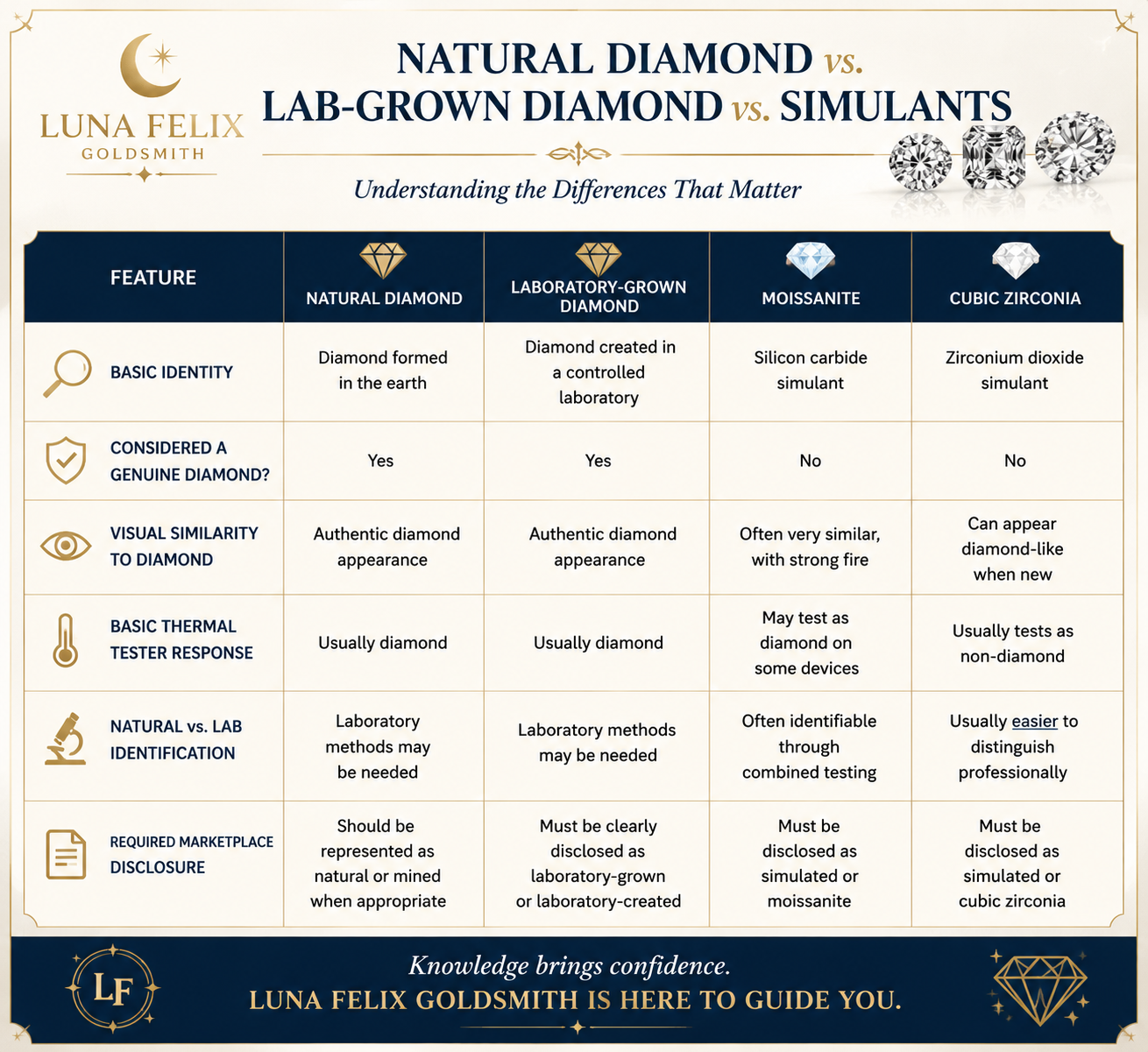
Natural and laboratory-grown diamonds are both genuine diamonds. They share the fundamental chemical, physical, and optical properties associated with diamond, but they form in different environments. Diamond simulants such as moissanite and cubic zirconia are different materials that are cut to resemble diamonds.
The Gemological Institute of America advises that the most reliable method of authenticating a diamond is evaluation by a trained gemologist or independent gemological laboratory. GIA also cautions that much of the internet advice about home testing is incorrect and that some suggested methods can damage the stone or its setting.
At Luna Felix Goldsmith in Santa Fe, selecting or evaluating a gemstone involves more than asking whether it sparkles. The stone’s identity, condition, cut, proportions, setting, documentation, and intended use all deserve careful consideration—particularly when the diamond will become part of a custom engagement ring, family heirloom, or one-of-a-kind piece of handcrafted jewelry.
What Does “Real Diamond” Mean?
The expression “real diamond” is often used loosely, which can create unnecessary confusion.
A clearer approach is to place stones into three broad categories.
Natural Diamonds
Natural diamonds formed within the earth over immense periods of time under conditions of extreme heat and pressure. They are composed primarily of crystallized carbon.
Laboratory-Grown Diamonds
Laboratory-grown diamonds are created in controlled environments through processes designed to reproduce the conditions under which diamond crystals form.
They are genuine diamonds—not imitations—but they are not mined diamonds. Advanced testing may be needed to distinguish them from natural diamonds because their basic material properties are so similar.
The Federal Trade Commission requires sellers to clearly disclose when a diamond is laboratory-grown or laboratory-created so that consumers are not led to believe they are purchasing a mined stone.
Diamond Simulants
A simulant is a different material designed or cut to resemble a diamond.
Examples include:
Moissanite
Cubic zirconia
White sapphire
Colorless topaz
Glass
A simulant may be attractive and appropriate for a particular design, but it should not be represented as either a natural or laboratory-grown diamond.
Can You Tell Whether a Diamond Is Real Just by Looking at It?
Sometimes an experienced jewelry professional can identify a likely simulant through magnification and observation, but appearance alone is not always conclusive.
A jeweler may examine:
Facet junctions
Surface wear
Luster
Inclusions
Doubling of facet reflections
Abrasion along edges
Light dispersion
Girdle features
Laser inscriptions
The way the stone is cut and polished
Certain clues may suggest moissanite, cubic zirconia, glass, or another material. However, the absence of those clues does not prove that a stone is a natural diamond.
Laboratory-grown diamonds can look virtually indistinguishable from natural diamonds without specialized equipment. Likewise, a well-cut simulant may appear convincing to an untrained observer.
The setting can make identification even more difficult. Metal may hide the girdle, pavilion, weight, or identifying features of the stone. Dirt and residue may also alter its appearance.
For these reasons, a visual examination should be treated as one part of the identification process, not as final proof.
Do Home Diamond Tests Work?
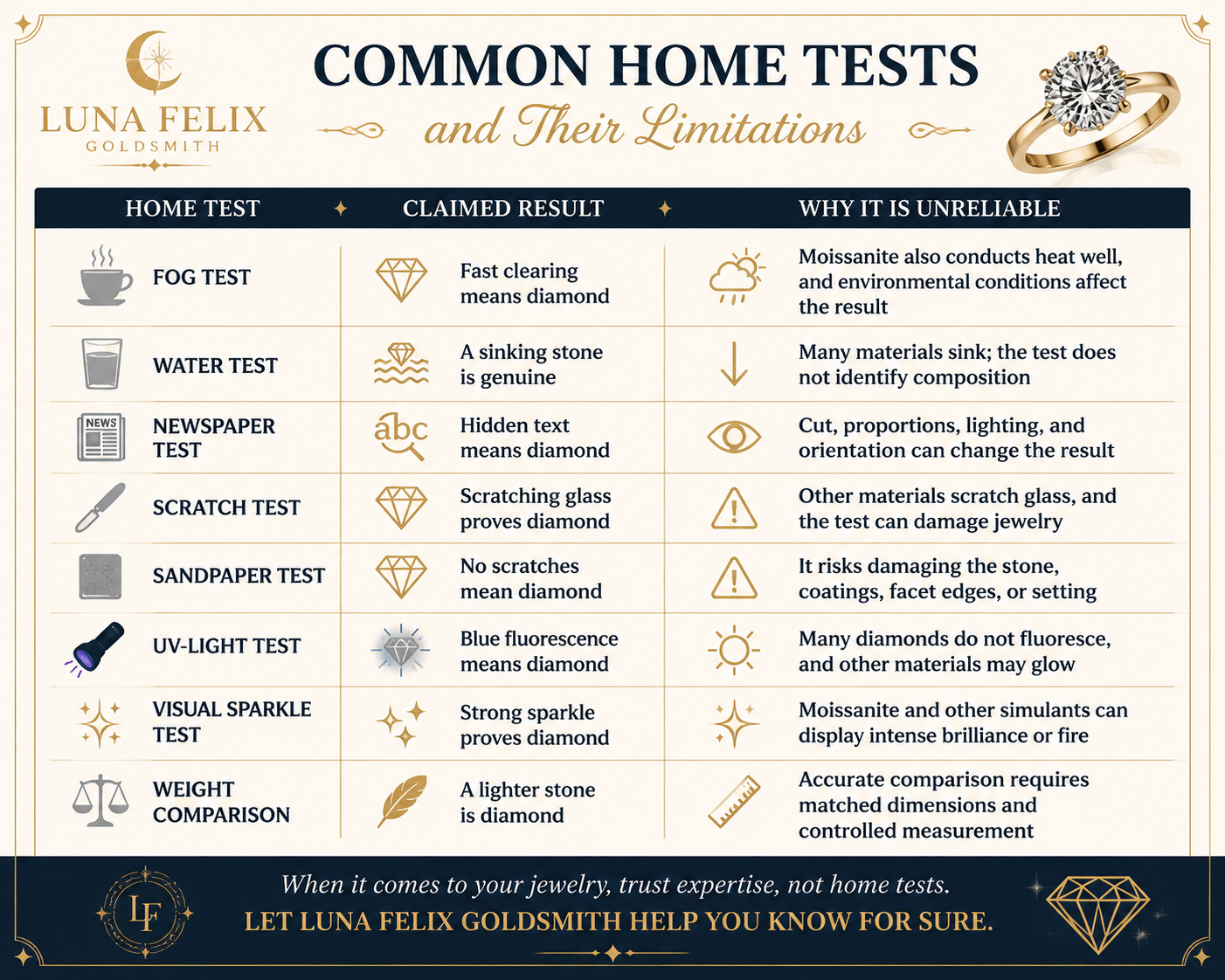
Many popular home tests are repeated online as though they provide definite answers. In reality, most are unreliable, incomplete, or potentially damaging.
At best, some tests may help identify an obvious imitation. They usually cannot distinguish every natural diamond from every laboratory-grown diamond or simulant.
The Fog Test
The fog test involves breathing on the gemstone and watching how quickly condensation disappears.
The theory is that diamond disperses heat efficiently, causing fog to disappear quickly. A simulant may hold moisture slightly longer.
The problem is that results can be affected by:
Room temperature
Humidity
Surface cleanliness
Stone size
The setting
Coatings
The person’s breath
How quickly the test is observed
Even if fog disappears rapidly, that does not establish that the stone is a natural diamond. Moissanite also conducts heat efficiently and may confuse a basic heat-based conclusion.
The Water Test
The water test usually involves dropping a loose stone into a glass of water and observing whether it sinks.
Many materials sink in water. A stone sinking does not prove it is diamond, while a mounted stone should never be subjected to this test.
The water test offers little meaningful information and creates a risk of losing or damaging a loose gemstone.
The Newspaper or Dot Test
This test places a loose gemstone over printed text or a drawn dot. If the lettering or dot can be seen clearly through the stone, some sources claim it is not a diamond.
The result depends heavily on:
Cut style
Facet arrangement
Proportions
Stone orientation
Lighting
Whether the gemstone is loose
The viewer’s angle
Some diamonds may produce confusing results, while certain simulants may not allow the text to be seen clearly. This is not a dependable authentication method.
The Scratch Test
The scratch test is based on diamond’s hardness and may involve scratching glass, metal, or another surface.
This test should be avoided.
A stone can be chipped, loosened, or damaged. The jewelry setting can also be scratched. Several materials can scratch glass, so the result does not prove the stone is diamond.
Hardness is only one gemological property, and destructive testing is not appropriate for valuable jewelry.
The Sandpaper Test
Rubbing a stone with sandpaper is another damaging internet recommendation.
Even if the gemstone itself resists scratching, the facet edges, coatings, treatment, surrounding metal, or setting can be harmed. No responsible evaluation should begin by intentionally abrading the jewelry.
The UV-Light Test
Some diamonds fluoresce under ultraviolet light, while others do not. The strength and color of fluorescence vary.
A glow under UV light does not establish that the gemstone is diamond, and the absence of fluorescence does not establish that it is fake. Other materials may also fluoresce.
UV examination can be useful to trained professionals as one part of a larger testing process, but it is not a conclusive consumer test by itself.
Can a Diamond Tester Tell You for Certain?
A conventional handheld diamond tester often measures thermal conductivity.
Diamond conducts heat very efficiently, so a thermal tester can separate diamond from many common simulants. However, some moissanite can also register as diamond on basic thermal-only devices because its thermal conductivity is relatively high. GIA has documented that this similarity can cause confusion and that additional properties and testing are needed to separate the materials reliably.
More advanced instruments may combine thermal and electrical-conductivity testing to better distinguish diamond from moissanite.
Even then, a basic tester may not determine whether a diamond is natural or laboratory-grown. Both are diamonds and can respond similarly.
Specialized screening technology uses optical or spectroscopic characteristics to separate natural diamonds from laboratory-grown diamonds and simulants. GIA’s iD100, for example, uses advanced spectroscopic technology to screen mounted and loose stones and refer uncertain results for additional testing.
A handheld tester can therefore be a useful tool, but the result must be interpreted within the limits of the instrument.
Is Moissanite a Real Diamond?
No. Moissanite is not diamond.
Moissanite used in jewelry is generally laboratory-created silicon carbide. It can be very durable and may display even more colorful fire than diamond, which some buyers enjoy.
Its optical and physical properties differ from those of diamond. Under magnification, a trained observer may notice double refraction or other identifying characteristics. Advanced conductivity testing can also help distinguish it.
Moissanite should be represented honestly as moissanite rather than described as a natural or laboratory-grown diamond.
GIA has reported cases in which synthetic moissanite carried fraudulent inscriptions matching genuine GIA diamond reports. That illustrates why an inscription or report number should be verified rather than accepted without comparison to the stone’s measurements and report data.
Is Cubic Zirconia a Real Diamond?
No. Cubic zirconia is a manufactured diamond simulant made from zirconium dioxide.
It can look bright and attractive, especially when new, but it differs from diamond in hardness, density, durability, optical properties, and long-term wear.
Cubic zirconia is generally heavier than a diamond of comparable dimensions and may show wear, scratches, or softened facet edges over time.
It is a legitimate jewelry material when disclosed accurately, but it should never be represented as diamond.
Is a Laboratory-Grown Diamond Fake?
No. A laboratory-grown diamond is a genuine diamond with a different origin.
It is not a diamond simulant.
Natural and laboratory-grown diamonds share the essential chemical composition and crystal structure of diamond. The meaningful distinction is whether the crystal formed within the earth or in a controlled production environment.
Because laboratory-grown diamonds may be difficult to separate from natural diamonds through ordinary observation, gemological laboratories use spectroscopy and other advanced techniques. GIA states that its laboratories can determine whether a diamond was produced through HPHT or CVD growth and can identify evidence of certain post-growth treatments.
Clear disclosure protects buyers and allows them to choose according to their preferences, values, and intended use.
What Professional Methods Are Used to Identify Diamonds?
A trained professional may use several complementary methods rather than relying on one test.
Magnification
A jeweler’s loupe or gemological microscope may reveal inclusions, growth features, abrasion, doubled facet reflections, polishing characteristics, or manufacturing clues.
Magnification can provide valuable information, but it may not conclusively separate natural from laboratory-grown diamonds.
Thermal and Electrical Conductivity
These instruments help distinguish diamond from many simulants. Combined testers are particularly useful for separating diamond from moissanite.
Refractive and Optical Observation
The professional may evaluate luster, dispersion, transparency, facet reflections, and other optical behavior.
Ultraviolet Examination
Fluorescence and phosphorescence patterns may provide clues when interpreted by someone with appropriate training and equipment.
Spectroscopy and Advanced Screening
Specialized instruments analyze how the gemstone interacts with light. These methods are particularly important when distinguishing natural from laboratory-grown diamonds.
Laboratory Analysis
When the stone is valuable, unusual, undocumented, or difficult to identify, submission to an independent gemological laboratory may provide the greatest confidence.
Professional identification is strongest when multiple observations support the same conclusion.
What Is a Diamond Grading Report?
A diamond grading report is an independent laboratory document describing the characteristics of a particular diamond.
For eligible natural diamonds, a GIA Diamond Grading Report may include:
Carat weight
Color grade
Clarity grade
Cut grade, when applicable
Measurements
Proportions
Finish
Fluorescence
A plotted clarity diagram
Other identifying information
GIA describes its Diamond Grading Report as a full assessment of the 4Cs, supported by proportion and clarity information.
A grading report is not the same thing as a monetary appraisal.
A grading report identifies and evaluates the diamond’s gemological characteristics. An appraisal generally assigns an estimated value for a stated purpose, such as insurance replacement.
Does Every Real Diamond Have a Certificate?
No.
Many genuine diamonds—particularly smaller stones, antique jewelry, inherited pieces, and stones already mounted in jewelry—do not have grading reports.
The absence of a report does not prove that the diamond is fake.
Likewise, the presence of a piece of paper does not by itself prove that the report belongs to the gemstone being examined.
The report number, measurements, weight, shape, clarity features, inscription, and other details should match the actual stone.
It is also more accurate to use the term grading report rather than certificate. A laboratory reports its findings about the gemstone; it does not guarantee future value.
How Do You Verify a GIA Report?
GIA provides an online Report Check service that allows users to confirm that the information on a report matches data stored in GIA’s database.
Verification should include more than confirming that the report number exists.
Compare:
Shape
Carat weight
Measurements
Color
Clarity
Fluorescence
Proportions
Report date
Laser inscription, when present
Identifying clarity characteristics
A fraudulent inscription may copy the number of a legitimate report while appearing on a completely different stone. GIA has encountered this type of deception involving both moissanite and laboratory-grown diamonds.
A professional should examine the gemstone and compare it carefully with the report.
Can a Fake Diamond Sparkle Like a Real One?
Yes.
Sparkle alone is not proof of identity.
Moissanite can display intense brilliance and colorful fire. Cubic zirconia can also look bright, particularly when clean and newly polished. Cut quality, lighting, cleanliness, setting style, and stone size all affect what the eye sees.
Diamond has its own characteristic balance of brilliance, fire, scintillation, hardness, and durability, but a consumer cannot reliably identify composition merely by deciding which stone “sparkles more.”
The better question is not whether a gemstone sparkles, but whether it has been accurately identified and represented.
Should Inherited Diamond Jewelry Be Evaluated?
Yes, especially when the jewelry has meaningful financial, historical, or sentimental value.
Inherited pieces may contain:
Natural diamonds
Old-cut diamonds
Diamond simulants
Replacement stones
Mixed natural and imitation stones
Damaged or loose gemstones
Worn prongs
Previous repairs
Valuable precious metals
Gemstones that were incorrectly described within the family
A professional evaluation can help clarify what the piece contains and whether it is safe to wear.
It can also support decisions about:
Insurance
Restoration
Resizing
Resetting the diamond
Redesigning the piece
Preserving original craftsmanship
Dividing inherited property
Creating a new family heirloom
At Luna Felix Goldsmith, jewelry evaluation can be approached as part of a broader conversation about craftsmanship, condition, stone security, and the future of the piece. The objective is not simply to attach a label to the stone, but to understand the jewelry as a complete work.
When Should You Seek Professional Diamond Evaluation?
Professional evaluation is especially important when:
Purchasing a diamond engagement ring
Buying a loose diamond
Comparing natural and laboratory-grown diamonds
Evaluating inherited jewelry
Verifying a grading report
Considering an online or private-party purchase
Insuring valuable jewelry
Resetting an existing diamond
Redesigning an heirloom
Questioning a seller’s description
A basic diamond tester gives an uncertain result
The gemstone has no documentation
The jewelry contains several similar-looking stones
The cost of a professional examination is often small compared with the cost of making a mistaken purchase or damaging a meaningful piece through an unsafe home test.
Questions to Ask Before Purchasing a Diamond
Before committing to a diamond, ask:
Is the diamond natural or laboratory-grown?
Has it received any treatment?
Is there an independent grading report?
Which laboratory issued the report?
Does the report match the stone?
Is there a laser inscription?
What are the diamond’s color, clarity, cut, and carat weight?
Can I view the diamond under magnification?
How does the stone perform in different lighting?
Is the setting appropriate for the diamond’s shape and intended use?
What care and inspection schedule is recommended?
What documentation will I receive?
Clear, direct answers are an important part of a trustworthy buying experience.
Frequently Asked Questions
How can I tell whether a diamond is real at home?
You may notice clues, but no common home test can conclusively identify every natural diamond, laboratory-grown diamond, and simulant. Professional examination is the safest and most reliable approach.
Can a jeweler tell whether a diamond is real?
A knowledgeable jeweler can often identify obvious simulants and use professional instruments to screen the stone. Difficult cases may require analysis by an independent gemological laboratory.
Is a lab-grown diamond a real diamond?
Yes. It is a genuine diamond created in a controlled environment rather than mined from the earth. It should be clearly disclosed as laboratory-grown or laboratory-created.
Is moissanite a diamond?
No. Moissanite is a different material that can resemble diamond and may register as diamond on some basic thermal testers.
Can cubic zirconia pass a diamond tester?
Most thermal diamond testers will identify cubic zirconia as non-diamond, but instrument quality, user technique, stone size, temperature, and setting conditions can affect results.
Does a real diamond always scratch glass?
Diamonds can scratch glass, but other materials can as well. Attempting the test can damage the stone or jewelry and should be avoided.
Can you identify a diamond by its sparkle?
No. Moissanite and other simulants may also display considerable brilliance and fire. Sparkle alone does not prove composition.
What is a GIA certificate?
The more accurate term is GIA grading report. The report documents the laboratory’s findings about a specific gemstone’s identity and quality characteristics.
Can a GIA report be fake?
A fraudulent or altered document—or a real report number assigned to a different stone—is possible. Use GIA Report Check and compare the report data with the actual gemstone.
Should inherited jewelry be professionally evaluated?
Yes. Evaluation can identify the stones and metal, reveal condition problems, support insurance decisions, and help determine whether restoration or redesign is appropriate.
Visit a Santa Fe Custom Jeweler for Diamond Guidance
A diamond often marks an engagement, anniversary, inheritance, or another meaningful moment. That significance deserves more than guesswork.
To discuss a diamond, inherited piece, or custom jewelry project, contact:
Luna Felix Goldsmith
116 W. San Francisco Street, Suite 208
Santa Fe, New Mexico 87501
Phone: 505-989-7679
Appointments are recommended.
Conclusion
Determining whether a diamond is real is not as simple as watching it fog, dropping it into water, scratching glass, or judging how brightly it sparkles.
Those methods may produce misleading results, and some can damage the stone or setting.
Professional identification considers several characteristics together. A jeweler or gemological laboratory may use magnification, conductivity testing, ultraviolet examination, spectroscopy, report verification, and other tools to determine whether a stone is a natural diamond, laboratory-grown diamond, moissanite, cubic zirconia, or another material.
It is equally important to understand that a laboratory-grown diamond is a genuine diamond, while moissanite and cubic zirconia are diamond simulants. Each can have a place in jewelry when described accurately and chosen knowingly.
For a meaningful purchase or treasured heirloom, confidence should come from transparent disclosure, appropriate documentation, and knowledgeable examination—not an internet shortcut.
Working with an experienced custom jeweler helps ensure that the gemstone is not only identified properly, but also selected, designed, set, and cared for with the attention required to become part of a lasting piece of wearable art.

Top Ten Precious Stones People Love in Jewelry
Diamonds might be a girl’s best friend, to borrow a phrase, but, for many collectors, other precious stones delight and amaze with their colors, their cultural value and, of course, their rarity.
In this post, we’ll explore the top 10 treasured gemstones used in jewelry worldwide.
Jewelry is one of humanity’s most expressive acts. Wherever people wear metal and stones, the adornment usually contains hidden stories, captured within the semi-precious stones set into its bed.
Diamonds might be a girl’s best friend, to borrow a phrase, but, for many collectors, other precious stones delight and amaze with their colors, their cultural value and, of course, their rarity.
In this post, we’ll explore the top 10 treasured gemstones used in jewelry worldwide.
Diamonds
A diamond is unquestionably the most coveted gemstone in the world of fine jewelry and its superior quality is backed up by extraordinary beauty and incredible staying power. Hardness speaks to the resistance of an object when pressed from one surface to another.
This extra-hard quality, among others, makes it extremely durable and desirable. The brilliance of this gemstone is said to be second to none and the translucency of a diamond allows it to sparkle like no other when light passes through it.
Beyond the specific cultural values of each branch of the global diamond trade, love is the most famous. Today, diamonds cost the most of all the gems available. Their rarity and emotional resonance ensures that they maintain the relevance of these associations. They continue to be the gem of choice for engagement and anniversary rings.
Sapphires
Rich, royal blue tones are Sapphire’s most common saturation, but the gemstone also shows up in pink, yellow, green and white. The sensory-resonant royal blue varieties are best-known – hence the name ‘stone of kings’.
British royalty were particularly fond of sapphires, and Princess Diana’s engagement ring became as much an icon as the princess herself. Sapphires are associated with wisdom, fidelity and sincerity. In the Middle Ages, members of the clergy wore them, to symbolise the serenity of heaven.
This September’s birthstone confers mystical powers on its wearer and bestows inner calm. Sapphire is a common gemstone that unites people across the globe because of its velvety blue sparkle and its associations with royalty spanning recorded history.
Emeralds
Emeralds, with their crystalline greens, seduce their owners to think of it as beauty and life. Trace amounts of chromium and vanadium give them their verdant greens. Ancient Egyptian royalty and Cleopatra herself coveted these emeralds, and many still do: Colombia supplies most of the world’s emeralds from its lush mines.
Emeralds score between 7.5 to 8 on the Mohs scale of hardness, less hard than both diamonds and sapphires, and making them more susceptible to physical damage. The interior structure also ensures that they are brittle, and lower-grade emeralds will normally have additional materials and oils, especially oil, worked into the fissures to toughen them.
Emeralds are May’s birthstone, and according to tradition, they are said to represent hope, growth, peace and tranquility. However, it’s emerald’s lustrous green color that played a deciding role in its status. Emerald was a gemstone coveted by nobility.
Rubies
Flames of love’s desire illuminate the ruby, while the intensity of love and passion are reflected in the red incandescence. The ruby was also called the ‘king of gemstones’, and the word itself comes from the Latin ruber (red) The red color in rubies comes from the element chromium.
The best rubies are a saturated, deep red with a touch of blue – called ‘pigeon’s blood’ red – and large rubies of pale pink and this color in high clarity can easily beat diamonds for value. Myanmar and Thailand are sources of fabulous rubies.
A ruby is a variety of in depth-colored red gemstone. On the Mohs’ scale of mineral hardness, ruby ranks a 9 (out of a possible 10). This makes it one of the most durable gemstones, and suitable for set in all kinds of jewelry.
It is designated the birthstone for July, and is traditionally seen as a symbol for passion, protection and prosperity. In many cultures it is valued as the most precious red gem, and Its bold color make it particularly suitable for gifts of romance.
Amethysts
Amethyst is a variety of crystalline quartz that has a strong purple and violet color. Amethyst owes its purple color to small amounts of iron. Deposits of amethyst can be found around the world.
Once highly popular and revered, in that distant prehistory, gods and goddesses both exalted amethysts as symbols of sobriety and spirituality. The purple amethyst formed the headpieces and jewelry of the old nobility and priests. Today this relatively inexpensive purple gem is still February’s birthstone and symbolizes peace, bravery and security.
Because amethyst has a Mohs hardness of 7, it can be used for jewelry of all kinds, and people still adore its calming purple. There are nuances of purple tone and saturation among the amethysts.
Opals
Opals are famed for their ‘play of color’: light enters an opal, its components are refracted and seen as flashes of all the colors of the rainbow, against the opal’s white ‘body color’. No two opals display quite the same color patterns. Indeed, that is what makes opals particularly desirable as gems.
This magical effect arises from the diffraction of light by the air gaps between silica spheres that are stacked in the lattice that comprises the opal. More than 90 per cent of the world’s supply of opals come from Australia. In ancient Rome, opals represented hope and virginity.
Opals’ position as the October birthstone means they now symbolize love, passion and desire. Their beauty is matched by their variability; with a hardness of between 5.5 and 6.5 on the Mohs scale, they’re softer than well-known stones such as quartz, amethyst, and semi-precious tourmaline, and sensitive objects should be kept away. However, this hardness cannot detract from the beauty of the rainbow flashes that give opals their appeal as a jewelry stone.
Aquamarine
The light blue to green-blue and crystal clear watery tones of aquamarine symbolise tranquility. Indeed, the name aquamarine translates from the Latin word for seawater. Its gentle and soothing ocean and water-blue colors invoke cool, calm feelings. This stone supports a sense of lightness, ease of energies, and enhanced clarity of expression.
Aquamarine is primarily mined in Brazil and also in Zambia. In terms of the Mohs scale of hardness, aquamarine scores between 7.5 to 8, and this stone can be worn daily. As March’s birthstone, the serene blue aquamarine symbolizes fresh beginnings and calm, and is perfect to be worn with the spring and summer looks.
Pearls
Pearls are the only gems that form within a living mollusc as layers of nacre – calcium carbonate – accumulate around an irritant inside the mollusc, resulting in this iridescent sheath.
Cultured pearls are nucleated by hand to force the oyster into producing nacre. Pearls appear from the classic white to black. The largest, roundest pearls with unblemished smooth skin and glow are the most valuable.
Pearl has long represented purity, wisdom and faith. It is between 2.5 and 4.5 on the Mohs scale (hardness index). It is very organogenic and its generally feminine pattern gives it a flavour useful in ornaments.
Garnets
However, they come in many different colors, from the deep red of pyrope garnets to the emerald green hues of uvarovite garnets. The best-known variety is the pyrope with its classic rich, red (often slightly brownish) color. Garnets were very fashionable in ancient Egyptian and Roman jewelry.
Garnet is still the birthstone for January today. Garnets continue to symbolise peace, prosperity, and good health. Garnets are rated 6.5 to 7.5 on the Mohs scale of hardness, which makes them hard enough for use in almost all jewelry. Garnets look good not only in rings, but in more modern styles for necklaces, bracelets and earrings, and their deep, warm, fiery glow can add life to any jewelry piece.
Topaz
Topaz, a rare silicate mineral, occurs in a dazzling palette of sky blue, sunshine yellow, rose pink, and crisp white. Blue topaz is the most-favoured, if inexpensive, of the varieties. Gem’s connoisseurs recognise topaz for its exceptional hardness, exceptional clarity, and exceptional shimmer (natural and not-so-natural).
Historically, topaz was also thought to afford both protection and healing, and to this day, topaz remains November’s birthstone while supposedly facilitating clear-sightedness and tempered strength.
A high-performing silicate mineral, topaz is a 8 on the Mohs scale – hard enough for all kinds of jewelry. Topaz comes from sources in Brazil, Mexico, Nigeria and the Ural Mountains.
Final Thoughts
Throughout history, they have been regarded as emblems of power and prosperity, protection and healing, even magic. Some were associated with the zodiac, others linked to healing, while royalty could own only precious stones. Precious stones are, perhaps, humanity’s greatest attempt to adorn itself with the pinnacle of nature’s gifts.