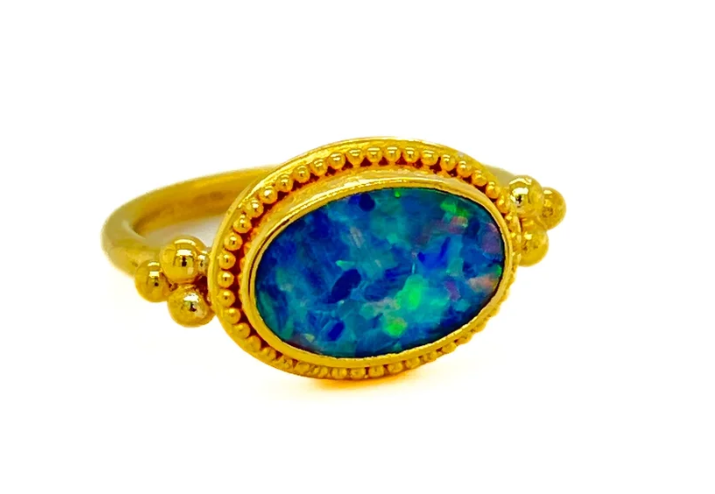
Why Is Gold Granulation Jewelry Considered a Rare Art Form?
Because gold granulation is an ancient technique for creating fine jewelry, many people consider it a rare art form. By soldering small gold granules together, this technique adds texture, dimension, and beauty to jewelry and creates wearable art.
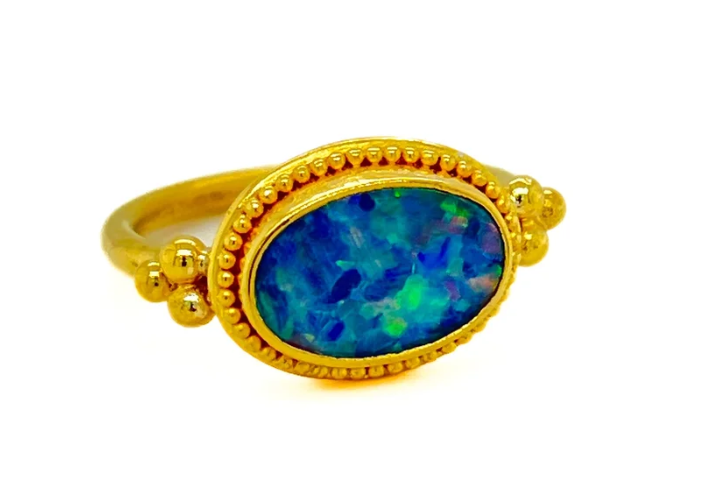
Because gold granulation is an ancient technique for creating fine jewelry, many people consider it a rare art form. By soldering small gold granules together, this technique adds texture, dimension, and beauty to jewelry and creates wearable art.
Luna Felix Goldsmith specializes in creating custom-designed gold granulation jewelry for rings, earrings, pendants, and other types of fine jewelry. To create custom-designed granulation jewelry, contact Luna Felix, one of Santa Fe, NM's top custom jewelry makers and designers.
Call our Santa Fe jewelry store, located at 116 W San Francisco St # 208, Santa Fe, NM 87501, Monday through Saturday, 10:00 AM to 4:00 PM, at 505-989-7679 to set up an appointment to meet with Luna!
The Origins of Gold Granulation
Gold granulation is an ancient technique with roots in Sumer (Mesopotamia), around 2500 BCE. Jewelry artisans from this civilization were able to create elaborate, stunning jewelry that continues to amaze today’s fine jewelry artisans.
Gold granulation was also used in the creation of many forms of beautiful handmade jewelry by the Egyptians, including necklaces, brooches, and earrings. In addition to the beautiful designs and workmanship, many of these pieces of jewelry were created with great detail and had religious symbolism (such as the Eye of Horus).
As time passed, other cultures embraced gold granulation and adapted it into their own traditional jewelry making techniques. In particular, the Etruscans (the dominant civilization in Italy between the 8th century and 3rd century BCE) incorporated gold granulation into their jewelry, which often used geometric patterns, floral patterns, and animal figures.
Gold granulated jewelry throughout Etruscan civilization was viewed not only as decorative but also as a representation of an individual’s rank and spiritual beliefs — the Etruscans believed in the power of destiny and in an active divine influence on all things.
How Does Gold Granulation Work?
Creating granulated jewelry is a highly skilled and time-consuming process. The first step in creating granulated jewelry is to lay out the small gold beads (granules) onto the surface of the jewelry in an intricate fashion.
To make granulation, jewelers use specialized tools and techniques. Jewelers typically use tools, such as tweezers, pliers, and small hammers, to place and arrange the granules on the surface of the piece.
To attach the granules, heat is applied to them using methods such as torching or laser fusion. Historically, a jeweler would fuse the granules by using copper salts as a bonding agent (copper salts melt at a temperature lower than gold), which allowed the granules to attach to the surface without fully melting.
Many modern-day goldsmiths now use soldering as a method to attach the granules, or use more precise temperature control to fuse the granules onto the surface of the piece. Traditionally, goldsmiths obtain granules of gold by cutting small pieces of thin wire and then heating them until they form spheres.
When finished with the initial design, goldsmiths then fuse the granules to the surface of the piece, following the design they created.
Gold Granulation as Compared to Milgrain
Gold granulation and hand milgrain are both techniques that were developed and used by artisans thousands of years ago, yet these two techniques are very different from one another. Artisans who created granulation placed tiny beads of metal (most commonly gold) on the surface of the piece of jewelry in order to create intricate patterns and designs.
The beads were attached to the surface of the jewelry using either heat or a bonding agent, and could cover a large portion of the surface area (attachment of the beads to the surface is typically done with very precise control of the amount of heat applied).
In contrast, hand milgrain is a technique used to create small bumps of metal along the edges of a piece of jewelry. The goldsmith uses either a small tool or engraving to create the tiny, evenly spaced bumps of metal along the edges of the piece of jewelry.
The term "milgrain" (literally meaning "a thousand grains") was first used in the early 20th century during the Edwardian and Art Deco periods. Milgrain is usually used when décorating the edges of a piece of jewelry in order to add a delicate and refined edge, enhancing the elegance of the piece without distracting from the focal point of the piece.
Thus, while both techniques are very unique in appearance, granulation adds texture and often complexity to a piece of jewelry, while milgrain technique enhances the lines and curves of a piece of jewelry.
Example of a German Ottonian Ring, 10th Century © The Metropolitan Museum of Art.
Characteristics of Gold Granulation Designs
Gold granulated jewelry from ancient Etruscan culture frequently contains geometrically arranged patterns with tiny equally spaced beads, creating intricate designs and textures for the finished piece of jewelry. Gold granulated jewelry from ancient Egyptian culture frequently uses natural patterns of flowers and stars, and uses other natural materials (i.e., lapis lazuli and turquoise) to create a contrast against the gold granules used in the design.
Gold granulated jewelry from ancient Greco-Roman cultures was influenced by earlier cultures, yet typically used more simple and refined designs (i.e., only small sections of each piece were designed with granules) than gold granulated jewelry of the Etruscan or Egyptian cultures. Typically, goldsmiths would use a few granulated beads to create contrast against the rest of the surface of a piece of jewelry.
Throughout history, gold artisans in India and the Islamic cultures combined granulation with other forms of delicate metal fabricating (filigree). Indian jewelry created with granulation represents a fluidity and lightness in appearance and is typically created or embellished with ornate and delicate work designed to reflect light and create the appearance of shimmer.
Modern goldsmiths are combining ancient techniques of making jewelry using gold granulation with modern technology to create unique pieces, including using old-fashioned methods (i.e., hand-fusing granulated beads without using solder) and using cutting-edge technology (laser) to improve the accuracy and precision of their work.
Goldsmiths have also created unique and different styles of jewelry in the modern world through the application of texture and light, as well as minimalist styles of jewelry using only a few granules of gold to create a subtle, yet beautiful, finished jewelry design.
Timeless Value of Gold Granulated Jewelry
Just as with fine jewelry with hand engraving, milgrain, and filigree, gold granulated jewelry is equally coveted based on the artistic beauty and the time and craftsmanship required to create each piece of jewelry. Each piece of gold granulated jewelry has some historical significance, which further enhances the value of gold granulated jewelry.
Luna Felix is a custom goldsmith and the owner of the Luna Felix Goldsmith jewelry store located at 116 W San Francisco St # 208, Santa Fe, NM 87501. If you have antique gold granulated jewelry that you wish to sell, or you would like to create custom gold granulated jewelry, please contact us to set up an appointment to visit the Luna Felix Goldsmith boutique jewelry store at 116 West San Francisco St, Santa Fe, NM 87501.
You can call us at 505-989-7679 to schedule an appointment with Luna or leave a message in our voicemail. We will contact you shortly! You can also contact us via e-mail using the contact form below.